
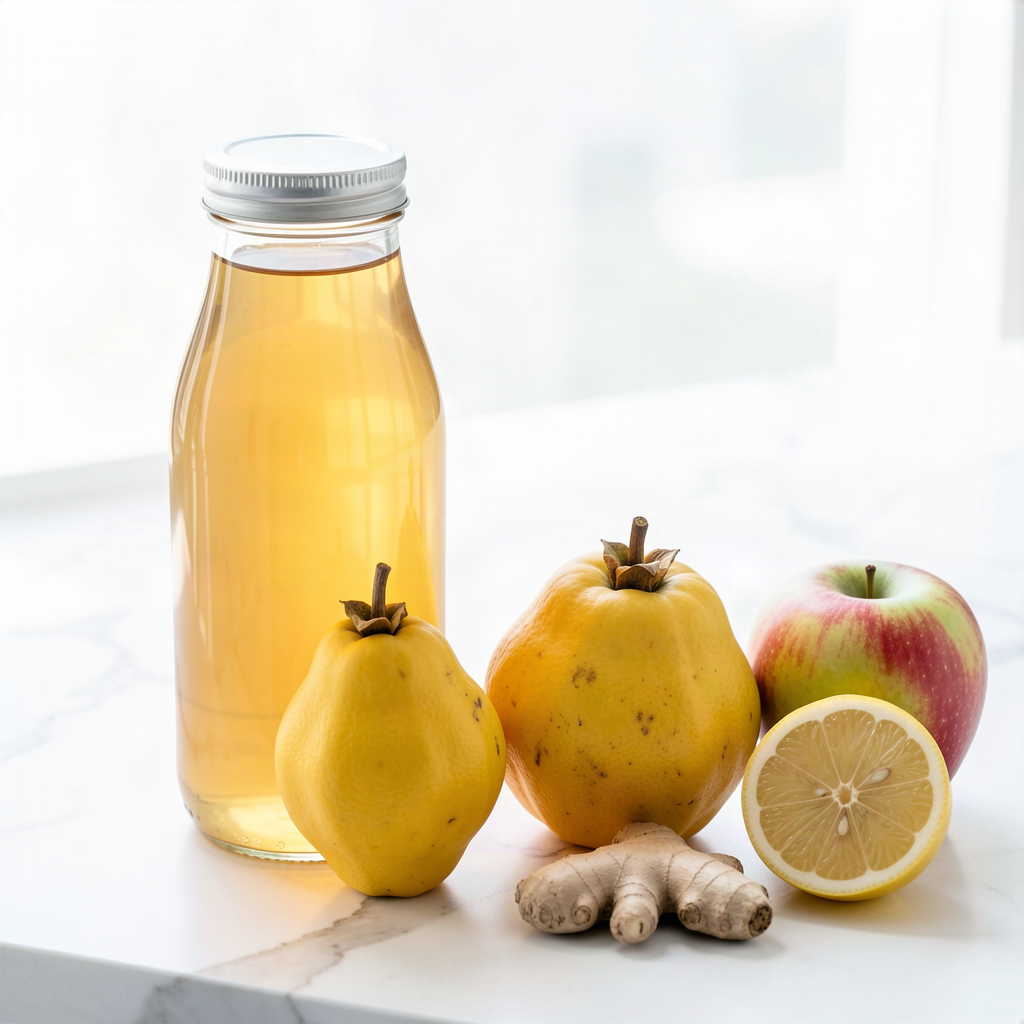
Quince is the awkward one in the fruit bowl. It sits there heavy and golden and knobbly, and then you bite one raw and get a mouthful of dry, hard, tart nothing. There is a reason nearly every quince recipe in the world simmers it with sugar for an hour. I still juice them every October, because with two sweet apples and a bit of ginger to lean on, raw quince turns into something I genuinely look forward to: sharp, floral, pale gold, with a dry grip at the end that took me a few glasses to appreciate.
Why these ingredients work
Quince is unusually tannic. Those gritty granules in the flesh are astringent compounds, mostly catechin and epicatechin, and unlike the pectin (which stays behind in the pulp when you strain) the tannins go straight through the juicer into the glass. That dry, mouth-puckering feeling is exactly why quince has been used across southern Europe and the Middle East for centuries to settle a loose or uneasy stomach, and there is a bit of published work behind the reputation. A double-blind trial in children with reflux found that adding quince syrup improved their symptoms. Read that one carefully though: the children were also on their usual treatment and the syrup was cooked, so it is encouraging rather than proof that a glass of juice fixes anything.
Ginger carries the other half, and it is the better evidenced half, because ginger is one of the few kitchen ingredients with solid trial support for nausea, including in pregnancy (Viljoen et al., 2014, Nutrition Reviews). The apples are there for sweetness, and their own pectin does not survive straining either, so treat them as flavour rather than fibre. One trade-off is worth stating plainly: a whole quince gives you roughly 1.9 g of fibre per 100 g and almost none of that reaches a strained glass, so this is a drink to sit alongside your vegetables rather than instead of them. One safety note too. Quince pips contain amygdalin, the same compound you find in apple pips and apricot kernels, so core the fruit properly and keep the seeds out of the juicer. You would have to crush and eat a lot of them for it to become a problem, but there is no reason to juice them.
FAQ
Do you have to peel quinces before juicing?
Yes, I would. The skin is tough and covered in a fine down you want to rub off anyway, and it holds a fair bit of the astringency. Peel them, cut them into wedges and take the core out.
Does quince juice need sugar?
Not in this version. The two sweet apples do that job, which is the whole point of making it fresh rather than simmering it, since most quince recipes are built around a cup or more of sugar. If you want it sweeter still, a teaspoon of honey in the glass is plenty. Do not expect apple juice either. Quince keeps a dry, almost wine-like edge whatever you pair it with, and that is the appeal.
Is quince juice actually good for your digestion?
The traditional reputation is real and there is a small amount of published work behind it, but it is thin. Quince has been used for centuries as an astringent for loose bowels and upset stomachs, and one double-blind trial found quince syrup helped children with reflux. That was a cooked syrup, in children, given alongside their usual medicine, so it does not tell you what a glass of fresh juice will do for an adult. What I can say is that it is a pleasant way to get ginger, which does have good evidence behind it for nausea, and that reflux or loose bowels which keep coming back are a GP conversation rather than a juice one.
More digestion recipes: see the full Digestion collection.
Quince, Apple and Ginger Juice
Equipment
- Nut milk bag
Ingredients
Ingredients
- 2 ripe quinces about 450 g, peeled, cored and cut into wedges
- 2 sweet apples such as Gala or Pink Lady, about 300 g, cored and quartered
- 1 thumb of fresh ginger about 15 g
- 1/2 unwaxed lemon peeled
For the blender method
- 100 ml cold water for simmering the quince
Instructions
Juicer method
- Wash the quinces and rub off the fine downy fuzz. Peel them, cut them into quarters and take the core out, scraping away the pips and throwing them in the bin rather than the juicer.
- Cut the quince flesh into wedges thin enough to fit your feed chute. Quince is very hard, so feed it slowly and let the machine do the work instead of pushing.
- Juice the quince wedges together with the apple quarters, the ginger and the peeled lemon half.
- Give it a stir, pour it into two glasses and drink it straight away, or bottle it and keep it in the fridge for up to 48 hours. It will darken a little as it sits, which is normal.
Blender method
- Peel and core the quinces and cut the flesh into chunks. Raw quince is far too hard to blend, so put the chunks in a small pan with the 100 ml of cold water, bring to a simmer and cook for 8 to 10 minutes until they soften. Leave them to cool completely.
- Tip the cooled quince and its cooking water into the blender with the cored apples, the ginger and the peeled lemon. Blend on high until it is completely smooth.
- Strain the lot through a nut milk bag or a fine sieve, pressing the pulp with the back of a spoon so you get all the juice out.
- Serve over ice, or chill it and drink within 48 hours.