
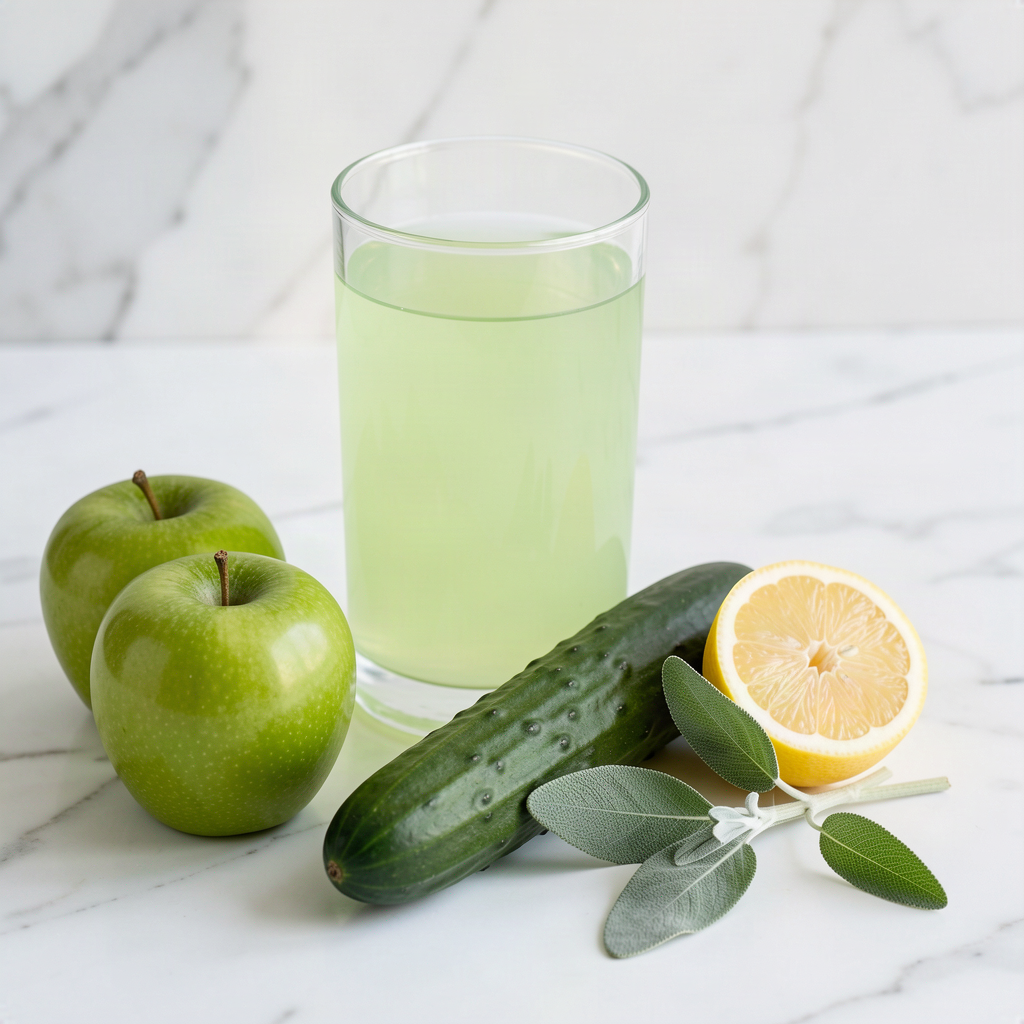
People have been claiming sage is good for the memory for about two thousand years. The old proverb asks why a man should die when sage grows in his garden, and the name Salvia is usually traced back to the Latin salvere, to heal. I am not going to oversell a herb, but sage is the one kitchen herb with real human trials behind it for memory, and it also makes a genuinely good drink. Sage juice on its own would be a mouthful of medicine, so the apple and cucumber carry the flavour and it ends up tasting green and herbal rather than bitter. I make it in the afternoon when I want something cold and sharp that is not another coffee.
Why these ingredients work
Sage has been through more human trials on memory and concentration than any other herb you would actually cook with, and the pattern is fairly consistent. Extracts and essential oils of common sage and Spanish sage have improved immediate word recall in healthy adults, and a four month study in people with mild to moderate Alzheimer’s reported better cognitive scores on sage than on placebo. A 2014 systematic review of the clinical trials, by Miroddi and colleagues, came to the same conclusion. The honest caveats matter though. Most of those studies used concentrated extracts rather than a glass of juice, so a handful of leaves is a food amount and not a clinical dose, and nobody has tested sage juice itself. What is solid is the chemistry, the volatile oils including 1,8-cineole and camphor alongside rosmarinic acid, and the apple gives you something pleasant to carry them in. The cucumber keeps the glass light at around 99 calories and adds potassium, and half a lemon brings about 17 mg of vitamin C.
FAQ
Does sage juice actually improve memory?
There is more evidence for sage than for any other herb you would put through a juicer, but this is not a memory pill. The trials show short term improvements in word recall from sage extracts and essential oils. Those preparations were concentrated, not juiced leaves, so treat this as a good drink made with a herb that has promising evidence behind it rather than a treatment. If you are actually worried about your memory, that is a conversation for your GP.
How much sage should I use?
A small handful, about 15 g, which is roughly a loosely packed cup of leaves picked off the stalks. Sage is a strong herb and doubling it makes the glass bitter rather than better. Use the leaves while they are fresh and bendy, because the dried stuff tastes dusty in a juice.
Who should be careful with sage?
Three groups worth knowing about. Sage has a long traditional use for reducing breast milk supply, so if you are breastfeeding keep to cooking amounts or leave it out. If you take warfarin or another blood thinner, the vitamin K in the leaves is worth a word with your GP before you make this a daily habit. And the concentrated sage essential oil is not the same thing as fresh leaves, it is not meant to be swallowed. Ordinary food amounts of fresh sage are fine for most people.
More brain recipes: see the full Brain collection.
Sage, Apple and Cucumber Juice
Equipment
- Nut milk bag
Ingredients
- 1 small bunch of fresh sage leaves about 15 g, picked off the woody stalks
- 2 crisp green apples Granny Smith or similar, roughly 300 g, cored and cut to fit your juicer
- 1/2 cucumber about 150 g, roughly chopped
- 1/2 lemon unwaxed, peel left on
Instructions
Juicer method
- Pick the sage leaves off the woody stalks and rinse them. You want a small handful, about 15 g, which is roughly a loosely packed cup.
- Quarter the apples and cut out the cores. Chop the cucumber into chunks and cut the lemon in half, leaving the peel on.
- Juice the apples and the cucumber first, then put the sage through sandwiched between two pieces of apple, which stops the leaves clogging the machine. Finish with the lemon.
- Stir it, pour it into two glasses and drink it straight away. It keeps about 24 hours in a sealed bottle in the fridge, though the sage gets bolder the longer it stands.
Blender method
- Pick the sage leaves off the stalks, core the apples, and roughly chop the cucumber and the lemon, leaving the peel on.
- Blend everything with 150 ml of cold water for about 60 seconds, until there are no large pieces of apple left.
- Tip the lot into a nut milk bag or a fine sieve set over a jug and squeeze the liquid through, then throw the pulp away. Skipping this step leaves you with a thick green puree rather than a drink.
- Serve as it is, or over ice if you want it cold. Give it a stir first because it settles as it stands.