
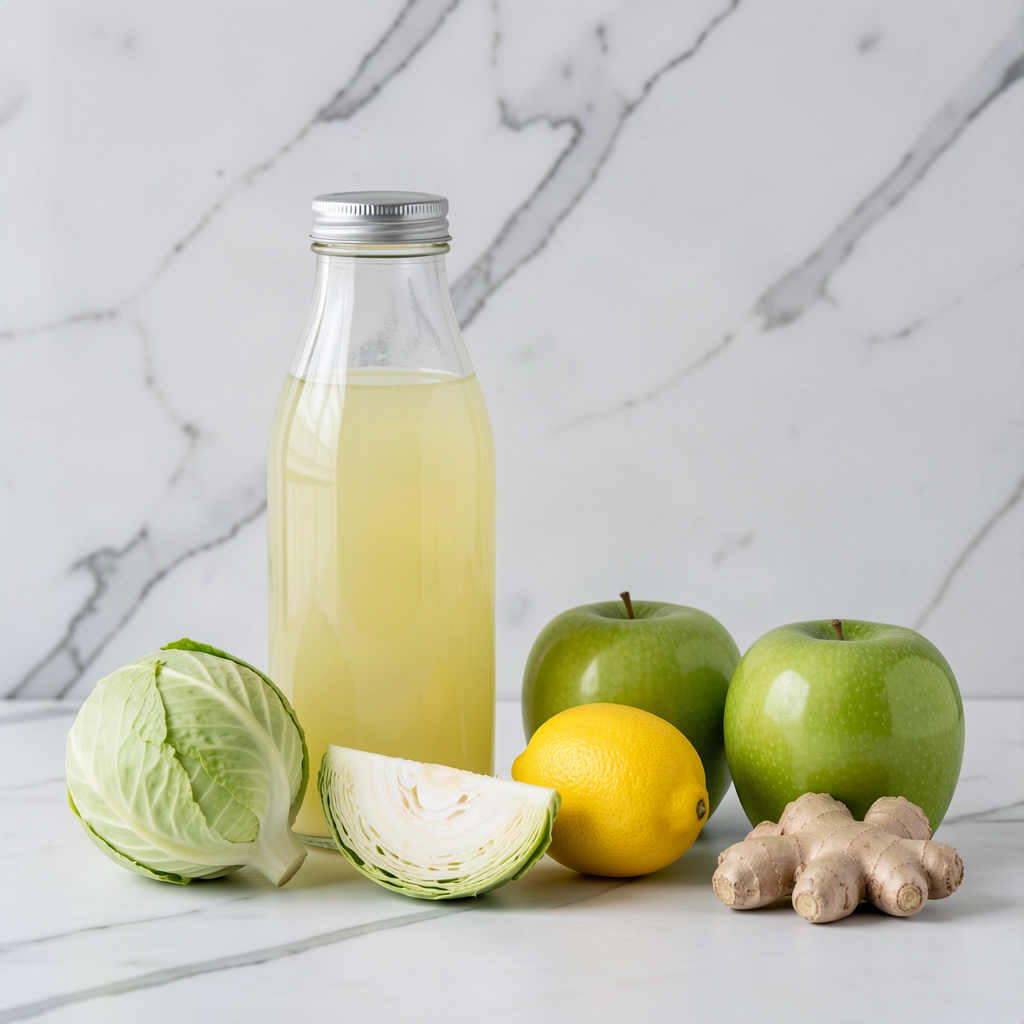
My nan kept a cabbage in the fridge the way other people keep a first aid kit. Any complaint about a sore stomach and out came the knife, a wedge of white cabbage and a bowl. I thought it was nonsense for years, then I went and read the hospital paper behind it and found she was working from something, even if that something is thinner than the family legend suggests. This is my version, and it is pressed with apple, lemon and a little ginger, because plain cabbage juice tastes like a wet lawn and nobody finishes the glass.
It takes about ten minutes and costs almost nothing. You want a pale, tight white or green cabbage, the ordinary one that costs less than a pint of milk, not a red one.
Why these ingredients work
Cabbage is a brassica, which means it carries glucosinolates, the same family of compounds that give sprouts and mustard their bite. When you cut or press the leaves the cells break open, an enzyme called myrosinase meets those glucosinolates, and you get the sulphur smell that hits you when you lift the lid. That smell is not a fault. It is the chemistry working, and it is one honest reason to press cabbage raw rather than boil it, because heat kills the enzyme before it has done its job.
The old stomach remedy has a real paper behind it. In 1949 Garnett Cheney, a doctor at Stanford, fed raw cabbage juice to patients with peptic ulcers and reported that they improved faster than the control group. He named the presumed active ingredient vitamin U, and that is where the story gets shaky, because vitamin U was never isolated and it is not a vitamin at all. The trial was small, the design was of its time, and we now know that most ulcers come from H. pylori infection or from anti-inflammatory painkillers, which is why nobody in a hospital is prescribing cabbage. So drink it because it is a decent, cheap green drink and because the tradition is interesting, not because it will fix an ulcer. If you have ulcer symptoms, get them looked at, and do not stop anything you have been prescribed.
What does stand up is the amino acid glutamine. It is the preferred fuel for the cells lining your small intestine, and cabbage is a reasonable everyday source of it. That is a mechanistic reason the old remedy was not pure superstition, and it is the reason I put cabbage on the digestion shelf rather than the detox one.
The apple is doing the sweetness, about 20 g of sugar a glass in total, and it brings potassium and a little vitamin C. The lemon cuts the sulphur and lifts the whole thing, and it carries the larger share of the 60 mg or so of vitamin C in the glass. The ginger is optional but I would not skip it: two centimetres takes the edge off the cabbage and settles the drink in a way that makes it something you would actually finish. Together they turn a medicinal brew into a sharp, clean green juice.
Two things worth saying plainly. First, straining removes most of the fibre, so this is not a fibre drink. A bowl of buttered cabbage gives you far more of that than a glass ever will. Second, cabbage is high in vitamin K, roughly 95 micrograms a glass, so if you take warfarin keep your greens steady rather than swinging from none to a jug. Anyone with a thyroid condition should not be drinking large amounts of raw brassica juice every day, and if you have IBS, cabbage is one of the vegetables that produces wind, so start with one glass and see how you get on.
FAQ
Does cabbage juice actually heal an ulcer?
Not in any way you should rely on. The 1949 study is small and old, the vitamin U it credited was never identified, and modern treatment means testing for H. pylori and using acid-suppressing medication. Cabbage juice is a pleasant green drink with a plausible gut connection through glutamine. It is not a treatment.
How much should I drink?
One glass of about 200 ml, most days if you like it. More is not better. The glass is a food amount rather than a dose, and large daily volumes of raw brassica are the point where the thyroid caution starts to matter. Keep it to one and eat the rest of your vegetables on a plate.
Why does it smell of sulphur, and can I stop it?
That is myrosinase turning glucosinolates into isothiocyanates once the leaves are cut. You cannot take it out without heating the juice, which defeats the point, so balance it instead: a little more apple, a squeeze more lemon, and drink it fresh. After two days in the fridge the smell is stronger, which is one reason not to batch it too far ahead.
More digestion recipes: see the full Digestion collection, including red cabbage, carrot and apple, Brussels sprouts juice and okra juice.

Cabbage, Apple and Lemon Juice
Equipment
- 1 Juicer any masticating juicer handles cabbage well
- 1 Budget cold press juicer the cheaper option, feed the cabbage slowly
- 1 High-speed blender for the blender method, with a nut milk bag
- 1 Budget blender works fine, just blend the cabbage a little longer
- 1 Nut milk bag for straining the blended version
- 1 Airtight glass bottles if you are making it ahead for the next morning
Ingredients
- 250 g white or pale green cabbage about a quarter of a small head, core removed, cut into wedges that fit your feed chute
- 2 crisp green apples about 300 g, cored, skin left on
- 1 unwaxed lemon halved, peel left on if you like it sharp
- 2 cm fresh ginger peeled, optional but it rounds off the cabbage
Instructions
Juicer method
- Cut the cabbage into wedges and slice away the hard triangular core. You want about 250 g, which is roughly a quarter of a small head.
- Wash and core the apples but leave the skin on, because the skin carries most of the sweetness and the colour. Peel the ginger if you are using it.
- Feed the cabbage through first, then the apples, then the ginger, and finish with the lemon halves. The apple and lemon push the cabbage through and rinse the last of the green out of the chute.
- Strain once more through a fine sieve if you want it completely smooth. The juice settles quickly, so give the glass a stir before you drink it.
- Drink it straight away, or bottle it cold and finish it within 24 hours.
Blender method
- Chop the cabbage as finely as you can and cut the apples and peeled ginger into small chunks. Blenders struggle with big handfuls of leaf, so add it a little at a time.
- Blend the cabbage with 100 ml of cold water first, until it looks like a rough green slush, then add the apples, ginger and the juice of the lemon.
- Blend on high for about a minute, until there are no visible chunks left.
- Tip the lot into a nut milk bag or a clean tea towel over a jug and squeeze it hard. It takes a few minutes and it is the step that turns a smoothie into a juice.