

I first made this because a neighbour with a moringa tree in her garden handed me a carrier bag of leaves over the fence and told me not to waste them. Moringa is not something I would buy for the fun of it. On its own it is grassy, faintly bitter, and it does not taste of much beyond green. Put it through a juicer with a cucumber and a couple of sharp green apples, though, and it turns into something I actually want to drink, because the apple carries the flavour and the leaves just make the glass clean and bright.
Moringa is the leaf of Moringa oleifera, a fast growing tree grown across South Asia and parts of Africa, where the leaves, pods and seeds are ordinary food rather than a supplement. The drumsticks you see in Indian grocers are its seed pods. The leaves are what we are juicing here.
Why these ingredients work
The honest starting point is that moringa has picked up a reputation as a cure for almost everything, and most of that is marketing. What survives the noise is much duller and more useful: it is a green leaf, and gram for gram it is a good one. If you have read that moringa carries several times the vitamin C of an orange, check what is being compared. Those figures are almost always for dried leaf powder against fresh fruit, and drying removes the water, so every number per 100 g multiplies. Compare fresh leaves with fresh leaves and moringa sits in the same league as spinach and kale. That is a perfectly good place to be, and it is no reason to spend twenty pounds on a pouch of powder.
For the bone side of things, fresh moringa leaves carry roughly 185 mg of calcium per 100 g, which is a real amount for a leaf, and they are high in vitamin K, which the body needs to direct calcium into bone rather than into soft tissue. The caveat is worth saying plainly: calcium in leaves is partly bound up as oxalate, so you absorb less of it than you would from milk or yoghurt. A glass of this is a decent top up, not a replacement for the dairy or the tinned fish in your week. If you want the longer version of that argument, the mustard greens juice covers the low oxalate greens properly.
The leaves also bring iron, and plant iron is awkward stuff: it is poorly absorbed on its own. This is where the apple and the lime earn their place rather than just making the drink taste nice. Vitamin C taken in the same glass genuinely improves how much of that non-haem iron you take up, which is one of the very few combinations in juicing with proper evidence behind it. The cucumber is doing the boring, essential job of stretching a small amount of very strong green liquid into two glasses you can drink without wincing, and the lime cuts through the grassiness the way lemon does on cooked spinach.
What you give up is fibre. Most of it stays in the pulp you throw away, which is why the glass only carries about a gram, and the roughly 18 g of sugar in it is all from the apples. Drink it as a green vegetable habit, not as a low sugar drink.
FAQ
What does moringa juice taste like?
Grassy and green, a bit like raw peas or spinach, with a faint bitterness right at the back of your tongue. The apple and lime cover most of it, and a cold glass tastes much cleaner than a warm one. If it is properly, sharply bitter rather than just green, your leaves are old: moringa goes bitter as it wilts, so use them within a couple of days of buying or freeze them.
Can I use moringa powder instead of fresh leaves?
Yes, but not in the juicer. Powder plus a juicer gives you a thick green paste that clogs the mesh and wastes the batch. Stir a level teaspoon into the finished juice, or blend it in at the end of the blender method. Remember the powder is the dried leaf, so it is far more concentrated than a handful of fresh leaves, and a teaspoon is plenty for two glasses.
Is moringa juice safe to drink every day?
A glass made this way is a food amount, not a dose of extract, so for most people it is fine. Two things are worth knowing. Moringa leaves are genuinely high in vitamin K, so if you take warfarin or another anticoagulant, keep your intake steady week to week rather than swinging about, and tell your anticoagulant clinic you are drinking it. The leaves also contain oxalate, so anyone with a history of calcium oxalate kidney stones should go easy. Only the leaves belong in the glass; the root, bark and seeds are not for eating. If you are on medication for diabetes, moringa may nudge blood sugar down, so ask your pharmacist before it becomes a daily habit, and if you are pregnant, keep it to ordinary food amounts and mention it to your midwife.
More bone health juices: see the full Structure collection.
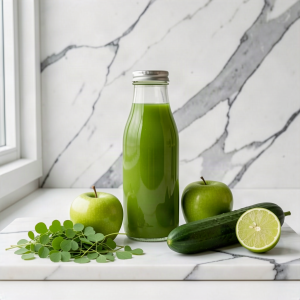
Moringa, Apple and Cucumber Juice
Equipment
- 1 Juicer any masticating juicer handles leaves well, a centrifugal one will throw moringa pulp into the jug
- 1 Budget cold press juicer the cheaper option, feed the leaves slowly between the apple pieces
- 1 High-speed blender for the blender method
- 1 Budget blender works too, just blend for the full minute
- 1 Nut milk bag for straining the blended version
- 1 Airtight glass bottles fill right to the top to keep the air off it
Ingredients
For two glasses
- 60 g fresh moringa leaves about two big handfuls, stripped off the stems, stems discarded
- 2 crisp green apples about 300 g, skin on, quartered and cored
- 1 cucumber about 300 g, a standard supermarket one
- 0.5 unwaxed lime peel on if unwaxed, otherwise peel it first
Instructions
Juicer method
- Strip the moringa leaflets off the stems with your fingers. The stems are tough and stringy and they wrap round an auger, so bin them. You want a loose 60 g of leaves, roughly two big handfuls.
- Feed the cucumber through first. It is mostly water and it wets the basket, which stops the dry leaves clogging the mesh before the juice starts flowing.
- Juice the two apples, then the moringa a handful at a time, alternating with apple so the leaves are always sandwiched between wet fruit instead of going through on their own.
- Juice the half lime last so the sharpness stays bright, stir the jug once, and either drink it straight away or bottle it right to the top and keep it in the fridge for a day.
Blender method
- Strip the leaves, chop the apples and cucumber into rough chunks, and put everything in the blender with 100 ml of cold water.
- Blend on high for 45 to 60 seconds until there are no leaf fragments left. Moringa is papery and it needs the full minute.
- Squeeze the lime in at the end rather than blending it, so the pith does not turn the drink bitter.
- Strain through a nut milk bag or a fine sieve, pressing the pulp with the back of a spoon, then bottle it. The strained version is best inside 24 hours.