
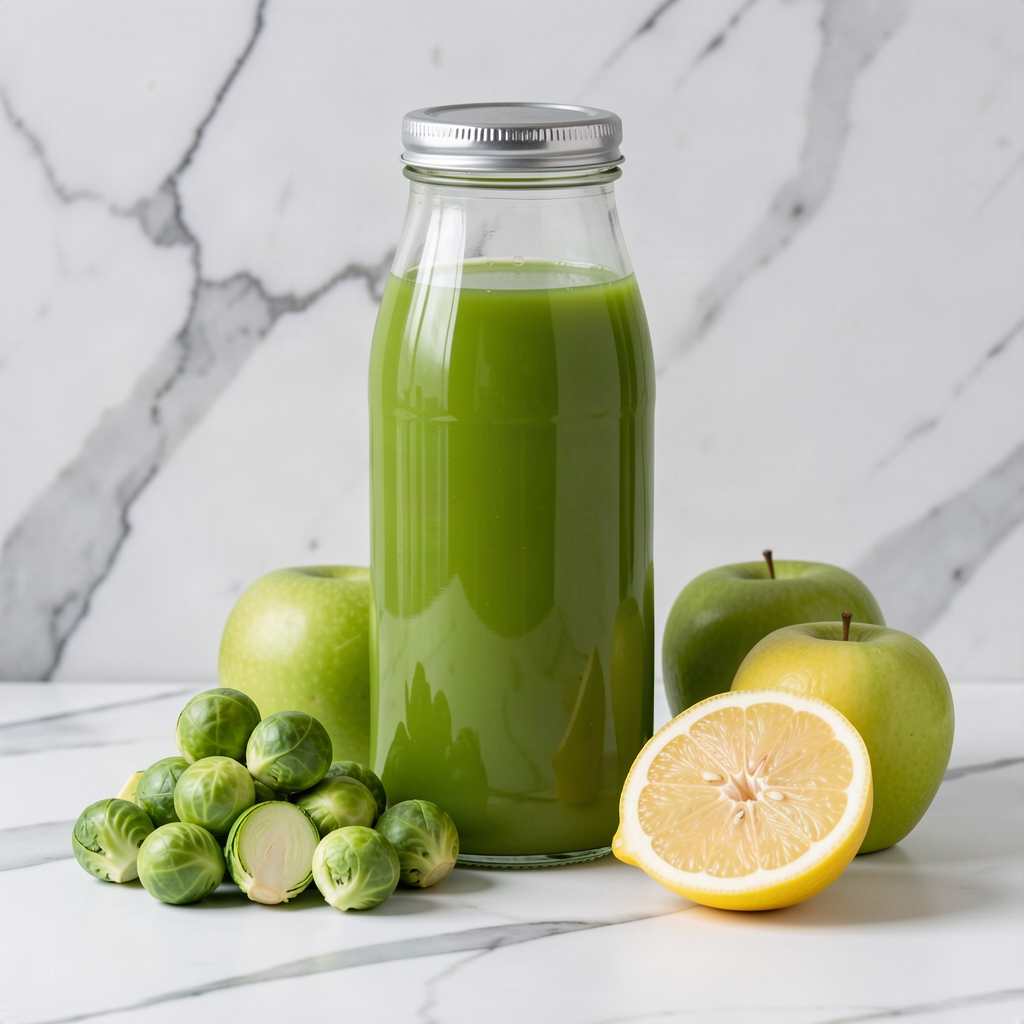
Brussels sprouts are the one green vegetable that is at its best exactly when not much else is, and they juice far better than people expect: sharp, green and far too strong to drink on their own, which is where the apple and the lemon come in. I started making this as a way to use up a bag of sprouts that would otherwise sit in the fridge until they went yellow. What keeps it in the rotation is the reason it works at all. Sprouts are full of glucosinolates, and those only become the compound everyone is actually interested in, sulforaphane, while the enzyme that does the converting is still alive. Boiling kills that enzyme and washes the glucosinolates into the pan. Juicing does neither.
Why these ingredients work
Brussels sprouts are a brassica, the same family as cabbage, broccoli and kale, and they are unusually rich in glucosinolates, the compounds behind their bitterness. When the plant’s cells are broken, an enzyme called myrosinase turns those glucosinolates into sulforaphane, which is the compound most of the research is really about. Cooking destroys that enzyme within a few minutes, and boiling also draws the water soluble glucosinolates out into the cooking water, so a raw juice is the one form where the conversion still happens in the glass. The human evidence is for eating sprouts rather than drinking them: a controlled trial by Hoelzl and colleagues in 2008 found that several weeks of eating Brussels sprouts protected the volunteers’ blood cells against oxidative and PhIP-induced DNA damage, and earlier work by Verhagen’s group pointed the same way. That is a sound reason to eat more brassicas, and I would not push it any further than that.
The apple is not there for decoration. Green apple brings the malic acid and the fruit sugar that make the sprouts drinkable, and its vitamin C helps stop the juice browning as it sits. Lemon does the same job and adds more vitamin C on top. Per glass this comes out at roughly 110 mg of vitamin C, which is more than a whole orange carries, and around 200 micrograms of vitamin K, which is a lot, so if you take warfarin or another vitamin K antagonist, keep your intake steady and mention it to your anticoagulant clinic rather than drinking it by the jug. One thing worth saying plainly: this is not a flush. Your liver and kidneys do the filtering on their own and no glass of juice makes them go faster. The honest case for this one is that it is a good way to get more brassicas in a form that keeps the enzyme cooking throws away.
FAQ
Do you need to cook the sprouts first?
No, and you should not if the sulforaphane is the point. The myrosinase enzyme that makes it is destroyed by heat within a few minutes of cooking, so raw is the only version where that conversion still works once the juice is in the glass. Just wash them properly in cold water, trim the bases and pull off any loose outer leaves.
Why does it taste so bitter?
Because the glucosinolates are bitter, and they are the same compounds the rest of this piece is about. Green apple and lemon blunt the edge of it. If it is still too much, add a carrot or a second apple, or top the glass up with sparkling water. Very bitter sprouts are also worth binning: buy them tight, bright and green rather than loose and yellowing.
How much of it should you drink?
One glass a day is a sensible ceiling. Raw brassicas contain goitrogens, which in practice only matter for people who eat very large amounts against a background of low iodine, but it is worth knowing if you have a thyroid condition. They are also hard on anyone with IBS, for the same FODMAP reasons that make sprouts notorious at Christmas. And be honest with yourself about the numbers: each glass carries about 19 g of sugar, and straining throws away most of the fibre a whole sprout would give you, so this is a drink rather than a shortcut.
More detox recipes: see the full Detox collection.
Brussels Sprouts, Apple and Lemon Juice
Equipment
- Juicer A masticating or cold press juicer copes with sprouts better than a centrifugal one and gets more liquid out of them.
- Budget cold press juicer The cheapest sensible way in if you are not sure you will stick at it.
- High-speed blender Use this route if you already own a blender and no juicer.
- Nut milk bag Only needed for the blender method, to strain the pulp out.
Ingredients
- 250 g Brussels sprouts about 12 to 14 sprouts, bases trimmed and any loose outer leaves pulled away
- 2 green apples crisp eating apples such as Granny Smith or Braeburn, cored but not peeled
- 1 lemon unwaxed, peeled and quartered
Instructions
Juicer method
- Trim the sprouts: cut away the hard bases, pull off any loose or bruised outer leaves, then cut each sprout in half. Give them a good wash in cold water.
- Quarter the apples and cut out the cores. There is no need to peel them. Peel the lemon, leaving as much of the white pith behind as you can, then cut it into quarters.
- Feed the sprouts through the juicer first, then the apple, then the lemon. Alternating the apple through with the sprouts helps push them through a centrifugal machine.
- Stir the juice, pour it into two glasses and drink it straight away. It will separate as it sits, so give it another stir before drinking.
Blender method
- Chop the sprouts and the apples and put them in a high speed blender with the peeled lemon and 200 ml of cold water.
- Blend on high for 60 seconds, until no lumps are left.
- Tip the lot into a nut milk bag or a fine sieve set over a jug, then squeeze or press it hard to get as much liquid out as you can. This is the slow part, but it is what makes it a juice rather than a smoothie.
- Serve over ice and drink it the same day.