
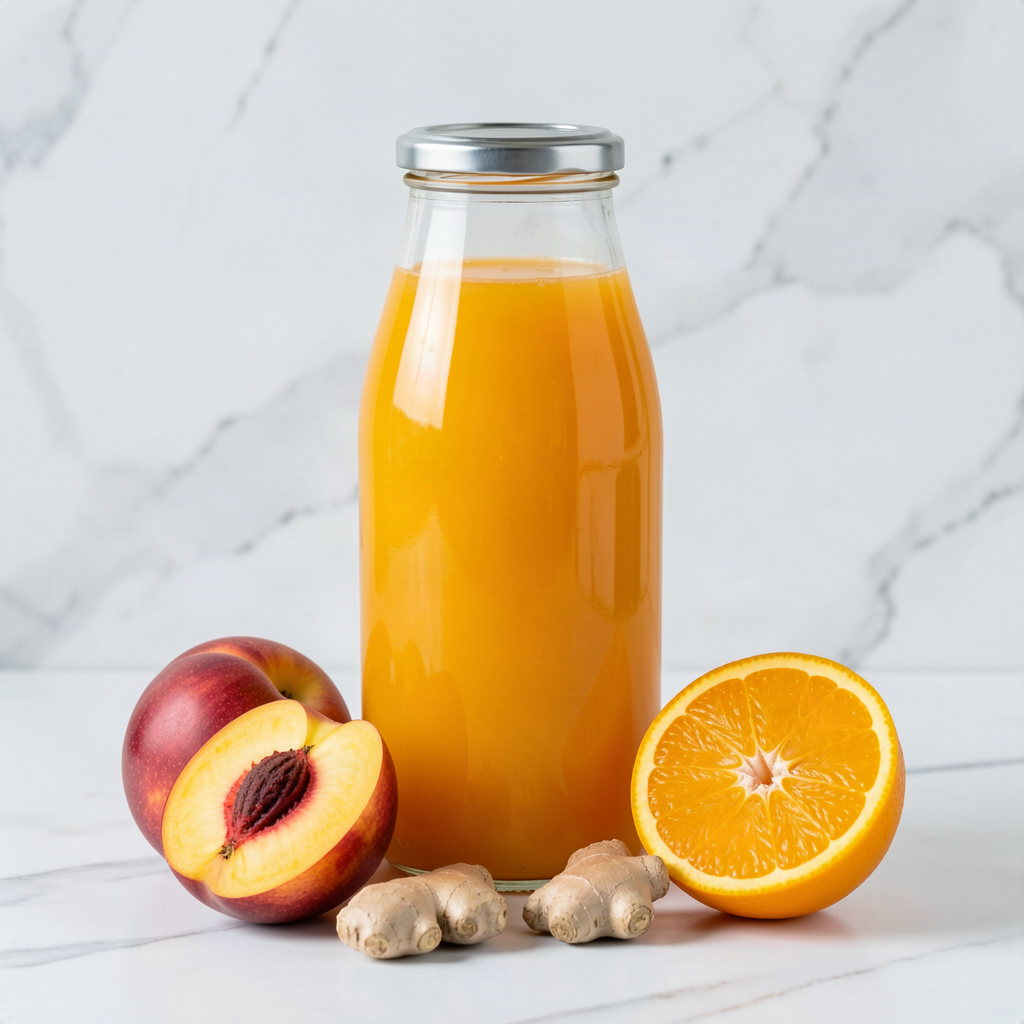
I make this one when nectarines are cheap and actually taste of something. Nectarine juice on its own is soft and a little flat, so the orange does the lifting and a small piece of ginger stops the whole thing tasting like baby food. It is a ten minute job that makes two glasses, and it is the drink I reach for before a training session rather than after, because it is fluid and fruit sugar at a point where both of those are genuinely useful. Do read the notes at the bottom of the recipe card though, because I would rather tell you plainly what a glass of juice can and cannot do than pretend it is a cure for anything.
Why these ingredients work
A nectarine is a peach without the fuzz, and each one brings roughly 200 mg of potassium. Potassium is the mineral you sweat out and the one your muscles and nerves actually run on, so a glass carrying about 700 mg is worth having around exercise. The oranges add a serious amount of vitamin C, around 90 mg in the finished glass, plus folate and more potassium, and their acidity is what stops the nectarine tasting cloying. Ginger earns its place twice over: it cuts through the sweetness, and it makes the glass feel lighter than a straight stone fruit juice does. Keep it to a small thumb, because ginger and nectarine are not natural friends and a big piece will simply take over.
One honest trade-off. Straining the juice means you lose most of the fibre a whole nectarine would have given you, which is the price of the flavour and of being able to drink three pieces of fruit in two minutes. If you want the fibre, make the blender version and do not strain it, but then call it a smoothie, because that is what it is.
FAQ
Do I need to peel the nectarines?
No. Nectarine skin is soft enough to go through a juicer or a blender, and it carries a decent share of the fruit’s antioxidants and colour. Wash them properly first, and if you are blending, the skin is part of what the nut milk bag catches. You should peel the oranges though, and take off as much of the white pith as you can, because the pith is what turns sweet citrus juice bitter.
Can I make it without a juicer?
Yes, use the blender method in the recipe card. Blend the fruit with about 100 ml of cold water, then pass it through a nut milk bag or a fine sieve and squeeze it out properly. You end up with a very similar glass. Without the straining step you have made a smoothie instead, which is fine, but it is a different drink with all of the fibre still in it.
Will this actually give me energy?
Partly, and only in a limited sense. You get fluid, roughly 30 g of natural sugar and about 700 mg of potassium, which is a sensible combination before exercise or at the point in the afternoon where you would otherwise reach for a second coffee. It will not fix fatigue that has a real cause behind it. Poor sleep, low iron, an underactive thyroid and simply not eating enough all feel like the same flat tiredness, and none of them are solved by a juice. If you are tired all the time, that is a conversation with your GP rather than a recipe, and I mean that sincerely.
More energy juices: see the full Energy collection.
Nectarine, Orange and Ginger Juice
Equipment
- Nut milk bag
Ingredients
- 3 ripe nectarines roughly 400 g, halved and stoned
- 2 oranges roughly 300 g, peeled, with as much of the white pith taken off as you can
- 1 small thumb fresh ginger roughly 15 g, peeled
- 1 handful ice cubes optional, to serve
Instructions
Juicer method
- Halve the nectarines and twist out the stones, then cut each half so it fits your juicer's feed tube. Leave the skin on. It is soft, it goes through fine, and it is where most of the colour and the antioxidants sit.
- Peel the oranges and take off as much of the white pith as you can, because the pith is what turns a sweet citrus juice bitter. Peel the ginger too.
- Feed the ginger through first, then alternate the nectarine halves and the orange segments. Putting the ginger in first means nothing else gets stuck behind it.
- Stir the juice once, pour it into two glasses over ice if you want it cold, and drink it within about fifteen minutes while the vitamin C is at its best.
Blender method
- Stone the nectarines and peel the oranges, then cut both into chunks and put them in the blender with the peeled ginger and about 100 ml cold water.
- Blend on high for about forty five seconds, until there are no lumps of fruit left.
- Pour it through a nut milk bag or a fine sieve set over a jug, then squeeze the bag to get the last of the juice out. What stays behind in the bag is the fibre, which is exactly why this version tastes thinner and cleaner than a smoothie would.
- Serve straight away, over ice if you like it cold, and give the glasses a stir before drinking because the juice settles.