
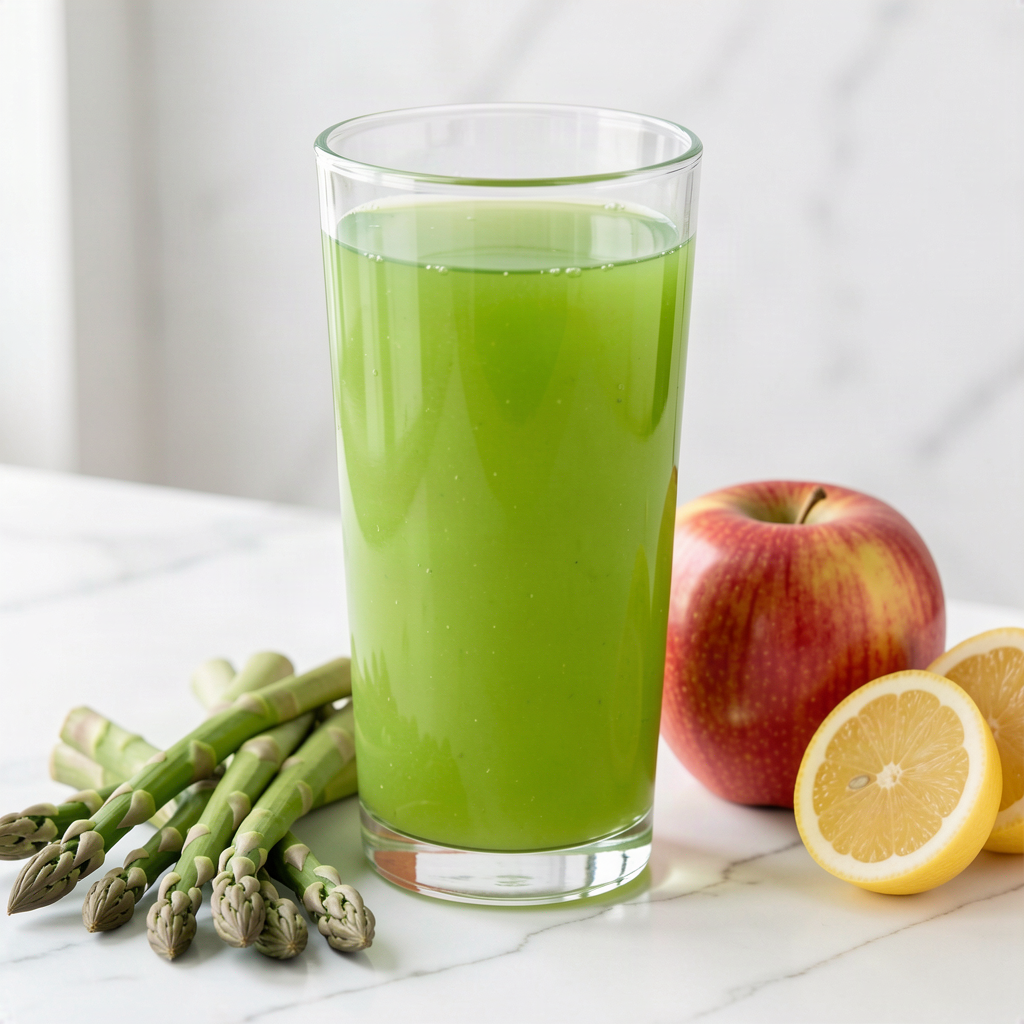
I buy asparagus through the short British season and then roast most of it, so the first time I put a whole bunch through the juicer I was not expecting much. What comes out is properly green: grassy and slightly savoury, not sweet. Two apples and a lemon are enough to pull it into balance, and it is ten minutes from bunch to glass.
It is also one of the few juices that keeps some fibre in the glass rather than leaving all of it in the pulp bin, because most of the fibre in asparagus is the soluble kind. That is the honest reason I make it. If you have read that asparagus juice cleans your liver or flushes your kidneys, that is not something the evidence supports.
Why these ingredients work
Asparagus carries around 2 g of fibre per 100 g, and most of it is inulin, a fructan that dissolves in water. Because it dissolves, a fair bit of it travels into the juice with the liquid instead of staying behind in the pulp, which is unusual for a juice. Inulin is a prebiotic, so the bacteria in your lower gut ferment it. That is the real case for asparagus in a gut health juice rather than the cleanse talk.
The rest is a decent nutrient spread. Asparagus is a good vegetable source of folate (about 52 micrograms per 100 g raw) and vitamin K (about 42 micrograms), and its iron figure is unusually high for a vegetable at roughly 2 mg per 100 g. The lemon is not only for taste. Vitamin C helps your body take up that iron, and it stops a green juice tasting flat. The apples bring the sweetness that makes the whole glass drinkable, plus a little potassium.
FAQ
Does juicing asparagus remove the fibre?
Mostly, yes, and that is true of nearly every juice. Asparagus is a partial exception because its fibre is largely soluble inulin, which passes into the liquid, so a glass lands at around 2 g of fibre. You do still lose the insoluble fibre that stays in the pulp, so a juice is not a swap for eating vegetables.
Why does asparagus make your urine smell?
Asparagus contains asparagusic acid, which your body breaks down into sulphur compounds that are volatile and leave in your urine. It happens quickly, often within 15 to 30 minutes, and not everyone can smell it in their own. It is harmless, and it only happens with fresh asparagus.
Can I drink asparagus juice every day?
It is fine as part of a mixed diet, but asparagus is high in vitamin K, around 42 micrograms per 100 g raw, so a glass of this carries roughly 52 micrograms. If you take warfarin or another vitamin K antagonist, a sudden change in vitamin K intake affects your INR, so keep your intake steady and check with your anticoagulant clinic before making it a daily habit. If you have gout or a kidney condition, ask your GP first as well.
More digestion juices: see the full digestion collection.
Asparagus, Apple and Lemon Juice
Equipment
- Nut milk bag
Ingredients
- 250 g asparagus woody ends snapped off
- 2 sweet apples Braeburn or Gala, roughly 300 g, quartered
- 1 lemon peeled
Instructions
Juicer method
- Snap the woody ends off the asparagus spears and cut the spears into short lengths that fit your juicer chute.
- Quarter the apples and peel the lemon, taking off as much of the white pith as you can.
- Feed the asparagus, then the apple, then the lemon through the juicer. The apple last helps push the grassy solids through.
- Stir the juice, pour it into two glasses and drink it fresh. It keeps for about 24 hours in a sealed bottle in the fridge.
Blender method
- Chop the asparagus and apples roughly and peel the lemon.
- Blend everything with 150 ml cold water for about 60 seconds until it is completely smooth.
- Tip the lot into a nut milk bag or a fine sieve set over a jug, then squeeze or press the liquid through. Do not skip this step, the point is the clear juice, not the puree.
- Serve as is, or over ice if you want it cold.