
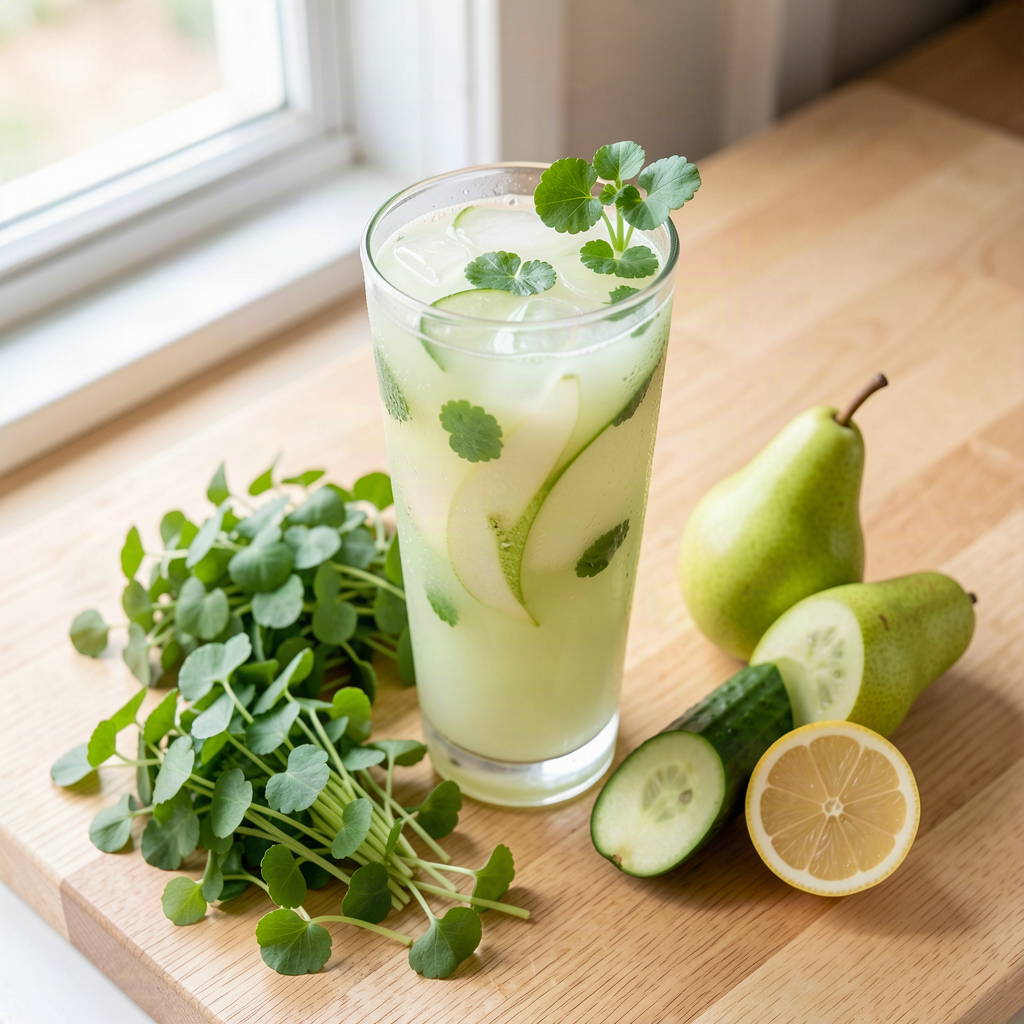
I got into watercress juice the way most people do, after reading that it is one of the few greens where the calcium actually makes it into the glass in useful amounts. My first attempt was pure watercress and I nearly wrote the whole idea off. It tasted like a field smells. But sweet pear and a cool cucumber change the picture completely, and this is the version I have stuck with. It has quietly become my favourite green juice.
Why these ingredients work
Watercress is the reason to drink this. A 100g bag carries around 120mg of calcium, more per gram than most other salad leaves, plus a serious amount of vitamin K, the nutrient that helps your body point calcium at bone rather than losing it. It is also one of the few vegetables whose calcium stays in the juice instead of getting left behind in the pulp. The pear brings the sweetness, so the glass tastes green but not punishing, and the cucumber adds water and bulk without shouting over the top. The lemon half does two jobs: it stops the juice browning, and its vitamin C helps your body absorb the plant calcium in the same glass.
FAQ
Can I use spinach or kale instead of watercress?
Yes. Swap in roughly the same weight of baby spinach for a milder glass, or kale if you want it grassier. You lose the peppery kick either way, but the vitamin K and calcium story is much the same, which is the main reason to drink it in the first place.
Is watercress juice good for your bones?
It is one of the better green juices for it. A glass of this recipe carries about 50mg of calcium and 85 micrograms of vitamin K, and the vitamin C from the lemon helps your body use the plant calcium. It is not a replacement for dairy or a supplement, just a decent daily top-up alongside the usual suspects.
Does it taste too peppery?
The first sip is more of a surprise than a problem. The pear does most of the calming down, so use two very ripe ones if you are nervous, or add half an apple as well. There is about 16g of sugar per glass, all of it from the fruit, which keeps this on the savoury side of the juice shelf.
More bone-health recipes: see the full Structure collection.
Watercress Pear and Cucumber Juice
Equipment
- 1 Juicer masticating or centrifugal
- 1 High-speed blender for the blender method
- 1 Nut milk bag or fine-mesh sieve to strain the blender version
- 2 Airtight glass bottles for storing
- 1 Budget cold press juicer a great value alternative
- 1 Budget blender a great value alternative
Ingredients
Juice base
- 100 g watercress, thick stems trimmed about a standard supermarket bag
- 2 ripe pears, cored conference or williams; the riper the sweeter
- 1/2 cucumber no need to peel
- 1/2 lemon, peeled the pith is what makes it bitter
- 100 ml cold water only if using the blender method
Instructions
Juicer method
- Wash the watercress and shake it dry. Trim off any thick woody stems, the thin ones are fine to juice.
- Core the pears and peel the lemon half. The cucumber goes in as is.
- Feed the cucumber through the juicer first, then the pears, then the watercress. Packing the leaves in with the firmer fruit stops them spinning around and getting stuck.
- Stir, pour into two glasses and drink straight away. It separates as it sits, so give it a swirl if you put it down.
Blender method
- Prep everything the same way: watercress washed and trimmed, pears cored, lemon peeled.
- Tip everything into a high-speed blender with the cold water and blend on high for 60 seconds, until completely smooth.
- Pour through a nut milk bag or a fine-mesh sieve and squeeze out as much juice as you can.
- Taste and thin with a splash more water if it is thicker than you like. Serve over ice.