
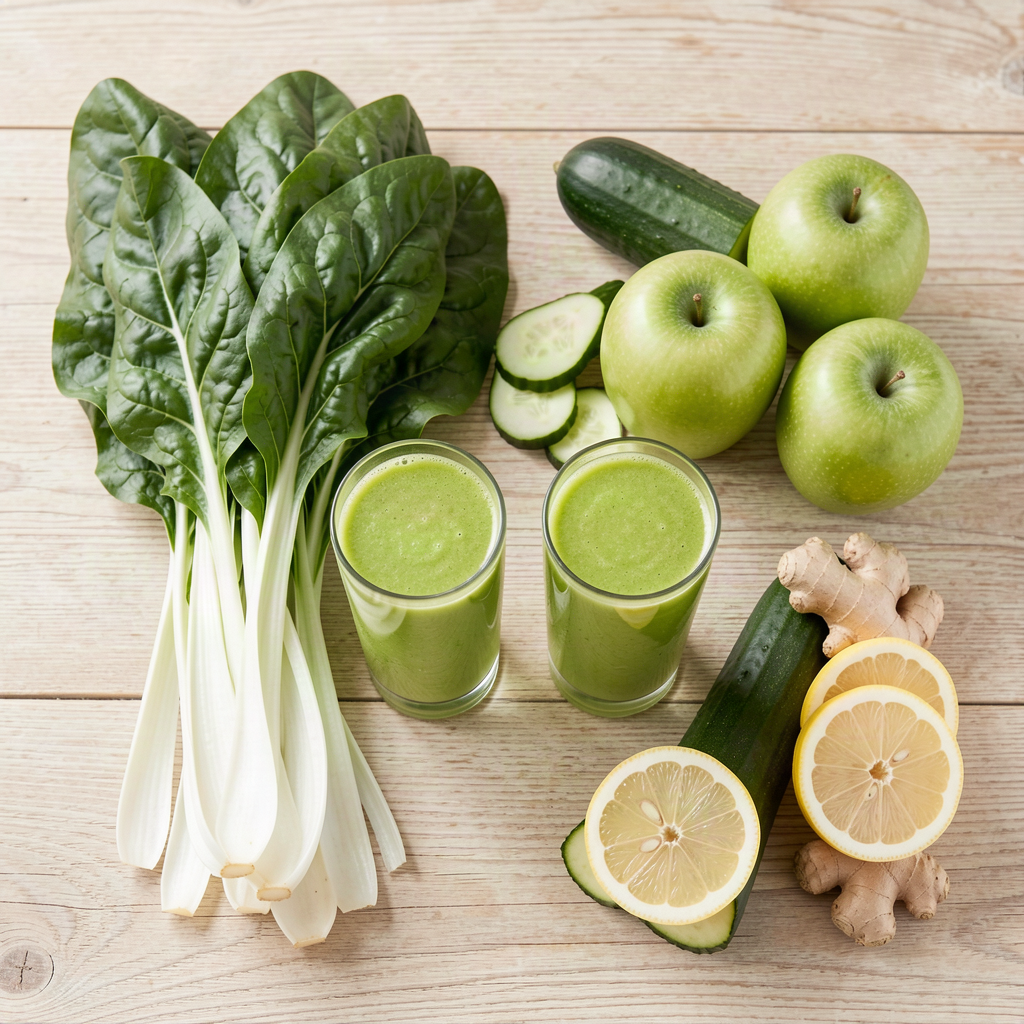
For years I treated Swiss chard as the awkward vegetable, the one in the veg box I would stare at before folding it into yet another pan of wilted greens. Then one September afternoon I juiced it with a sweet apple on a whim, mostly to use it up, and I have not looked back. Raw chard has a mild, mineral flavour with a faint saltiness that comes from the plant itself, and apple smooths it into something genuinely drinkable rather than worthy. It is one of those juices that tastes like a good decision, if that does not sound too smug.
The timing works out nicely too. Chard has a second flush in late summer and through September, so the bunches at the market right now are young and tender. And of everything I juice on a regular rotation, chard is the one I think of as my bones green. A glass of this carries around 300 micrograms of vitamin K, several times the reference amount you see on food labels, and vitamin K is the nutrient that helps calcium actually find its way into bone rather than washing straight through. I am not going to pretend a glass of green juice is the whole answer to bone health, because it is not, but as one small daily habit among several, it is a good one.
Why these ingredients work
Swiss chard is the point of this juice. Gram for gram it is one of the highest vegetable sources of vitamin K around, and it also brings magnesium and a useful amount of vitamin C, both of which play their own part in keeping bone tissue healthy. One honest caveat: chard is high in oxalates, which bind to some of its calcium, so I would not sell this to you as a calcium drink. Its real job here is the vitamin K side of the bone equation, which is exactly the nutrient most people get least of.
The rest of the glass is about making that green drinkable. Sweet apples carry most of the flavour and the natural sugar, and a whole glass comes to about 18g of sugar, comparable to orange juice, so I treat it as a juice rather than as water. Cucumber adds volume and a clean, hydrating base without much flavour of its own. Lemon sharpens the whole thing and protects the colour, and a small thumb of ginger adds warmth at the end of each sip. Between them they turn what could be a stern green juice into one I actually look forward to.
FAQ
What does Swiss chard juice taste like?
Mildly earthy and a little mineral, with a faint salty note that is natural to chard rather than added. It is nowhere near as bitter as kale can be, and much softer than raw spinach. The apple does most of the work: with a sweet variety like Gala or Jazz the juice ends up closer to apple juice with a green edge, and the ginger leaves a gentle warmth on the finish.
Can I use rainbow chard instead?
Yes, and it is the same plant, just with coloured stems. Rainbow chard juices almost identically, though the red and pink stems will turn the juice a murky brown-green rather than the fresh bright green you get from white-stemmed chard. That does not change the taste much, but if you are making this for a photo or serving it to someone who eats with their eyes first, stick with the white-stemmed bunches.
Is it safe to drink chard juice every day?
For most people, a glass a day is fine, and at 110 calories with 540mg of potassium it is a reasonable everyday choice. The caveat is oxalates. Chard is naturally high in them, and unlike boiling, juicing does not reduce them, so anyone with a history of calcium oxalate kidney stones should talk to their GP before making this a daily habit. Everyone else: one glass, not a litre, and you are on safe ground.
More bone-health recipes: see the full Structure collection.
Swiss Chard and Apple Juice
Equipment
- 1 Juicer masticating or centrifugal
- 1 High-speed blender for the blender method
- 1 Nut milk bag or fine-mesh sieve to strain the blender version
- 2 Airtight glass bottles for storing
- 1 Budget cold press juicer a great value alternative
- 1 Budget blender a great value alternative
Ingredients
- 150 g Swiss chard leaves about 4 big leaves. Rinse well and chop roughly, juicy white stalks included
- 2 sweet apples about 300g, quartered. Gala or Jazz work well; the sweeter the apple, the less green it tastes
- 100 g cucumber roughly a third of one, no need to peel
- 1/2 lemon peeled so the pith does not make it bitter
- 10 g fresh ginger peeled, about a thumb-sized piece
- 150 ml cold water only if using the blender method
Instructions
Juicer method
- Rinse the chard well and shake off most of the water. Chop it and the apples into pieces that fit your feed tube, peel the lemon and ginger, and cut the cucumber into chunks.
- Feed the chard through the juicer a handful at a time, pushing an apple wedge through behind each handful. Leafy greens can cling to the auger, and the apple clears it. Follow with the cucumber, then the lemon and ginger.
- Stir the juice, pour into two glasses and drink straight away. If you want it cold, chill the ingredients for an hour first rather than adding ice and watering it down.
Blender method
- Put the chard, apples, cucumber, lemon and ginger in a blender with the cold water. Blend on high for 45 to 60 seconds, until completely smooth.
- Pour through a nut milk bag or fine-mesh sieve and press well with the back of a spoon to get every drop out.
- For a little more fibre, leave some of the pulp in. Pour into two glasses and drink straight away.