
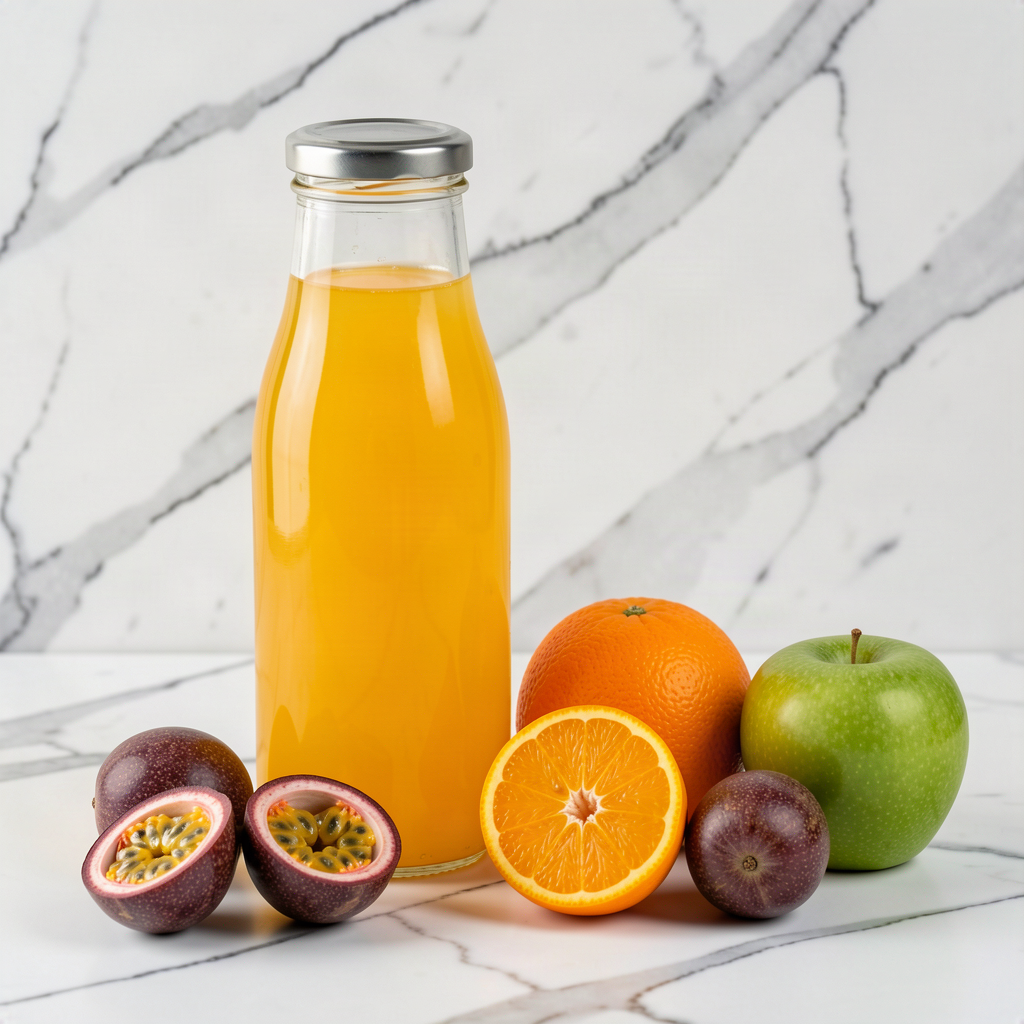
Passion fruit is usually a pudding fruit. It turns up on a pavlova, spooned over a cheesecake or stirred into a cocktail, and almost never in a glass on its own. I started juicing it because I had a bowl of wrinkling ones going spare, and it turned out to be one of the few fruits that carries a genuinely useful amount of potassium and a little iron. That is the honest reason it sits on this page. The only fiddly part is the seeds.
Why these ingredients work
Passion fruit carries around 348 mg of potassium per 100 g of pulp, which puts it in the same league as a banana, and about 1.6 mg of iron per 100 g, which is unusually high for a fruit. The orange does two jobs here. It gives the glass the volume and sweetness that passion fruit on its own does not have, and its vitamin C is what helps your body absorb that iron, so the two ingredients genuinely work as a pair. The apple rounds the whole thing off and keeps it balanced. What you do lose is fibre, because it is a fine sieve that turns this into a drink rather than a purée, so keep eating fruit whole if fibre is the thing you are after.
FAQ
Can you make passion fruit juice in a juicer?
Partly, but the seeds are the problem. A juicer will press the pulp happily enough, and there is no reason to put the hard black seeds through the machine. The cleanest way is to scoop the pulp and press it through a fine sieve or a nut milk bag first, then run the orange and apple through the juicer as normal and stir the two together. If you only have a blender, blitz the pulp with a splash of water for about 20 seconds, strain it, and carry on from there.
Is passion fruit juice good for you?
It is a decent glass. You get around 565 mg of potassium and roughly 1.1 mg of iron, plus about 100 mg of vitamin C carried in the orange. Be realistic about the size of it though. That iron is a nudge rather than a treatment, and a glass carries about 30 g of sugar, so it is a drink rather than a cure. If tiredness is a real problem and not just a bad week, the useful next step is a blood test from your GP, not another glass of juice.
Does passion fruit juice help you sleep?
That reputation belongs to a different plant. The calming remedy sold as passionflower comes from the leaves and flowers of a related species, and it is the fruit you are juicing here, which has none of that sedative history. There is nothing wrong with a glass in the evening, but treat it as a drink and not as a sleep aid, and keep taking sleep seriously if it is causing you trouble.
More energy juices: see the full Energy collection.
Passion Fruit Juice for Energy: Orange and Apple
Equipment
- Nut milk bag
Ingredients
For the juice
- 6 ripe passion fruit about 90 g of pulp
- 2 large oranges peeled (about 300 g of flesh)
- 1 large sweet apple cored (about 200 g)
Instructions
Juicer method
- Halve the passion fruit and scoop the pulp into a small bowl with a spoon. Press it through a fine sieve, or squeeze it in a nut milk bag, into a jug so you keep the golden juice and leave the hard black seeds behind. The seeds are edible but tough, and a juicer will not thank you for pushing them through.
- Peel the oranges and pull off the thick white pith, keeping as much of the soft flesh as you can. Run the orange segments and the cored apple through the juicer.
- Stir the strained passion fruit juice into the orange and apple juice and give it a quick taste.
- Pour into two glasses, or two bottles if you are taking it out, and drink it cold and fresh.
Blender method
- Scoop the passion fruit pulp into the blender with 100 ml of cold water and blitz for about 20 seconds, just long enough to loosen the pulp off the seeds. Do not blitz hard or long, or you will shred the seeds and the juice turns bitter.
- Strain that through a fine sieve or a nut milk bag into a jug, then rinse the blender out.
- Roughly chop the peeled oranges and the cored apple, blend them with another 100 ml of cold water until smooth, then strain through the same sieve or bag.
- Stir the two juices together, taste, and pour into two glasses. Drink it cold.