
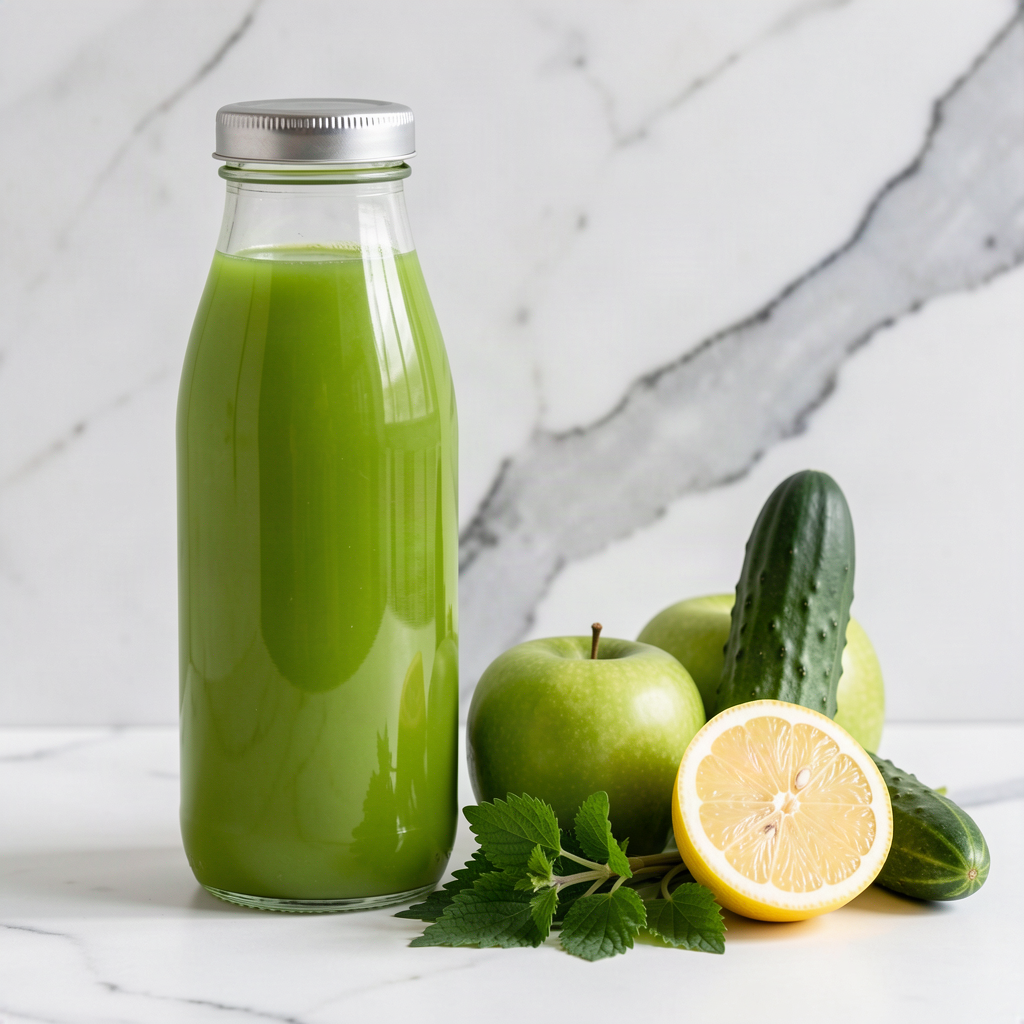
I started picking nettles for soup years ago and only got round to putting them through the juicer recently, mostly because I could not quite believe a free hedgerow leaf could taste this green. It does, once you cut it with sweet apple and cucumber. The sting never reaches the glass, because the juicer breaks those little hairs before anything gets near your mouth, and what is left is a dark, grassy, surprisingly clean drink. I make mine in the autumn off a patch I cut back earlier in the year, when it has put out a fresh set of tender tops.
Why these ingredients work
Nettle is the whole reason for the glass. It is a genuinely mineral dense dark leaf, carrying calcium, vitamin K, beta-carotene and a little iron, and it is one of the few things on this site you can pick for nothing. Two honest notes before you get carried away. Nettle is a mineral accumulator, which means it takes up whatever is in the soil it grew in, so a patch on rich ground can read several times higher than a patch a field away, and any single published number is a snapshot of one patch rather than a fact about nettles. And the popular claim that nettles beat spinach on calcium is usually comparing dried nettle powder with fresh spinach, which is not a fair fight. The solid part is the vitamin K, and vitamin K is what activates osteocalcin, the protein that binds calcium into bone, so a dark leaf earns its place on a bone page that way rather than through the calcium headline. The sweet apple does two jobs at once, it carries the green flavour and it keeps a soft leaf moving through the basket, while the cucumber and the lemon lighten the whole glass so it stays drinkable rather than heavy.
One practical caution. If you take warfarin or another vitamin K antagonist, keep your nettle intake steady rather than swinging about week to week and tell your GP or anticoagulant clinic you have added it. Nettle is also a mild diuretic, so a glass is sensible and a pint every afternoon is not, and anyone with a kidney stone history should go steady because the leaf is not free of oxalate. Concentrated nettle extracts are advised against in pregnancy even though a small amount of the cooked leaf has long been a spring vegetable, so if you are pregnant check with your midwife first.
FAQ
Do nettles still sting once they are juiced?
No. The sting comes from hollow silica hairs on the leaf that snap off when you brush them and inject formic acid along with histamine, serotonin and acetylcholine. Those hairs are fragile, and the juicer and the blender both destroy them, so a nettle that stings your hand does not sting your glass. Wear gloves while you pick and rinse them all the same, and pick away from roadsides, sprayed verges and anywhere dogs are walked.
Do I need to pick nettles before they flower?
It is the long standing rule and it is worth keeping to. Once nettles flower, the leaves develop cystoliths, gritty calcium carbonate crystals, and the old foraging advice is that these are harder on the kidneys. That part is tradition rather than a tested finding, so treat it as a sensible habit and not a hard warning, but the leaves also go tough and stringy once the plant is setting seed, so the young tops simply taste better. Spring is the classic time, and any patch that has been cut will put out tender tops again into the autumn.
Is nettle juice actually high in calcium?
Nettle is a real source of calcium and, unlike spinach, it is low in oxalate, so more of that calcium is available to you than spinach gives. The problem is the numbers. The figures you see quoted, sometimes 600 mg or more per 100 g, come from dried nettle leaf or nettle powder. Weighed like for like against fresh spinach, a fresh nettle leaf is a good green vegetable rather than a bone cure, and because nettle takes its minerals from the soil, the real figure swings enormously from patch to patch. Drink it for the vitamin K and the dark leaf nutrients, not as a measured dose of anything.
More bone friendly juices: see the full Structure collection.
Nettle, Apple and Cucumber Juice
Equipment
- Nut milk bag
Ingredients
For the juice
- 50 g young stinging nettle tops the top four to six leaves of each plant, picked before it flowers
- 2 sweet apples cored (about 300 g)
- 0.5 cucumber about 150 g
- 0.5 unwaxed lemon peeled if you want it softer
Instructions
Juicer method
- Rinse the nettles in a colander and pull the leaves away from the thicker stalks. Wear gloves while you do it. A rinse does not blunt the sting, only breaking the hairs does, and the juicer is what does that.
- Feed the apples and the cucumber through first so the basket is already wet and moving, then drop the nettle leaves in a handful at a time, alternating each handful with a piece of apple. Nettle is a soft leaf and it needs something firm alongside it or it simply spins round the basket.
- Squeeze in the lemon, stir and taste. Nettle is grassy with a faint bitterness underneath, and if it is too green for you, add a little more apple.
- Pour into two glasses or two bottles and drink it cold and fresh.
Blender method
- Blend the nettle leaves with 150 ml of cold water for about 30 seconds, then strain through a nut milk bag or a fine sieve into a jug. This is also what breaks the sting, so nothing stinging ever reaches the glass.
- Blend the cored apples, the cucumber and the lemon juice, then strain that through the bag as well, pressing the pulp with the back of a spoon to get the last of it out.
- Stir the two juices together, pour into two glasses or bottles and drink it cold.