
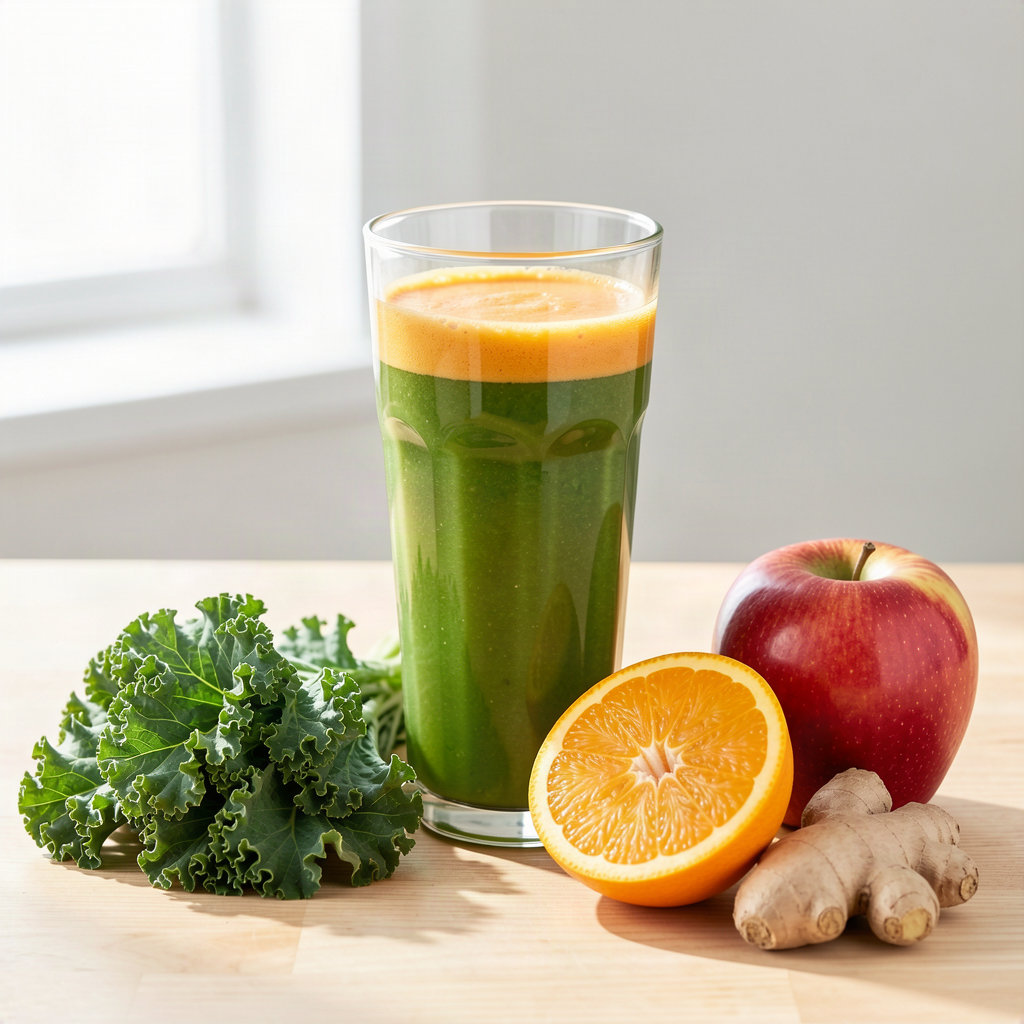
I came to kale juice late, because my first attempt tasted like the garden it came from. The trick is to stop treating kale as the whole drink and start treating it as a guest. Two oranges and a sweet apple carry it, a knob of ginger keeps the glass interesting, and suddenly the greenest thing in my kitchen is one of the nicest things in my glass. I have been making this since early autumn, when the kale in the shops gets properly good, and it is the green juice I keep coming back to.
Why these ingredients work
Kale is the reason to drink this. A 100 g handful of raw kale carries roughly 150 mg of calcium, more per gram than most leafy greens, and it is low in oxalates, the compounds in spinach that bind calcium and stop your body absorbing it. So the calcium in kale is calcium you are actually likely to keep. The oranges are not just there for the sweetness: their vitamin C is what your body needs to build collagen, the flexible frame that bone mineral sits in. One glass of this recipe gives you about 60 mg of calcium, 150 micrograms of vitamin K to help point it at your bones, and a decent share of your daily vitamin C in the same glass.
FAQ
Is kale actually good for your bones?
Yes, and it is underrated. A 100 g handful of raw kale has about 150 mg of calcium, close to a fifth of the 700 mg adults in the UK need each day, and unlike spinach it is low in oxalates, so more of that calcium is available to your body. A glass of this juice supplies around 60 mg of it, plus 150 micrograms of vitamin K, the nutrient that helps direct calcium to your bones rather than out of your body. It is not a replacement for dairy or a supplement, just a decent daily top-up.
Does it taste too green?
Not with this combination. Curly kale is the mildest of the kales, and two oranges plus a sweet apple give the juice real body, so it lands on the sweet side of the juice shelf. There is about 16 g of sugar per glass, all of it from the fruit. If yours still tastes too earthy, add half an apple more next time, and always strip the thick stalks first, because they are the part that turns bitter.
Can I use frozen kale or make it ahead?
Frozen kale juices fine straight from the bag, which is handy outside the autumn and winter months. Let it thaw for a few minutes and squeeze out the worst of the water before juicing. As for making ahead, this one is best in the first hour, but it keeps in an airtight bottle in the fridge for up to two days, and a good shake brings it back together because the pulp settles.
More bone-health recipes: see the full Structure collection.
Kale and Orange Juice
Equipment
- 1 Juicer
Ingredients
- 100 g curly kale, thick stalks removed
- 2 large oranges, peeled
- 1 sweet apple such as Gala or Pink Lady, cored
- 10 g fresh ginger, peeled
- 200 ml cold water (for the blender method)
Instructions
Juicer method
- Wash the kale and shake it dry, then strip the leaves from the thick stalks, which are tough and bitter. Peel the oranges and roughly chop them. Core the apple and cut it into quarters. Peel the ginger.
- Feed the kale through the juicer a handful at a time, then the apple and ginger, and finish with the oranges. The wet orange flushes the last of the green pulp through the machine and sweetens everything as it goes.
- Stir the juice, pour it into two glasses and drink straight away.
Blender method
- Roughly chop the kale. Peel and chop the oranges and the apple, and peel the ginger.
- Put everything in a blender with 200 ml cold water and blend on high for 60 to 90 seconds, until the kale is completely broken down.
- Strain through a nut milk bag or a fine-mesh sieve, squeezing well to get every drop out. Pour into two glasses and serve.