
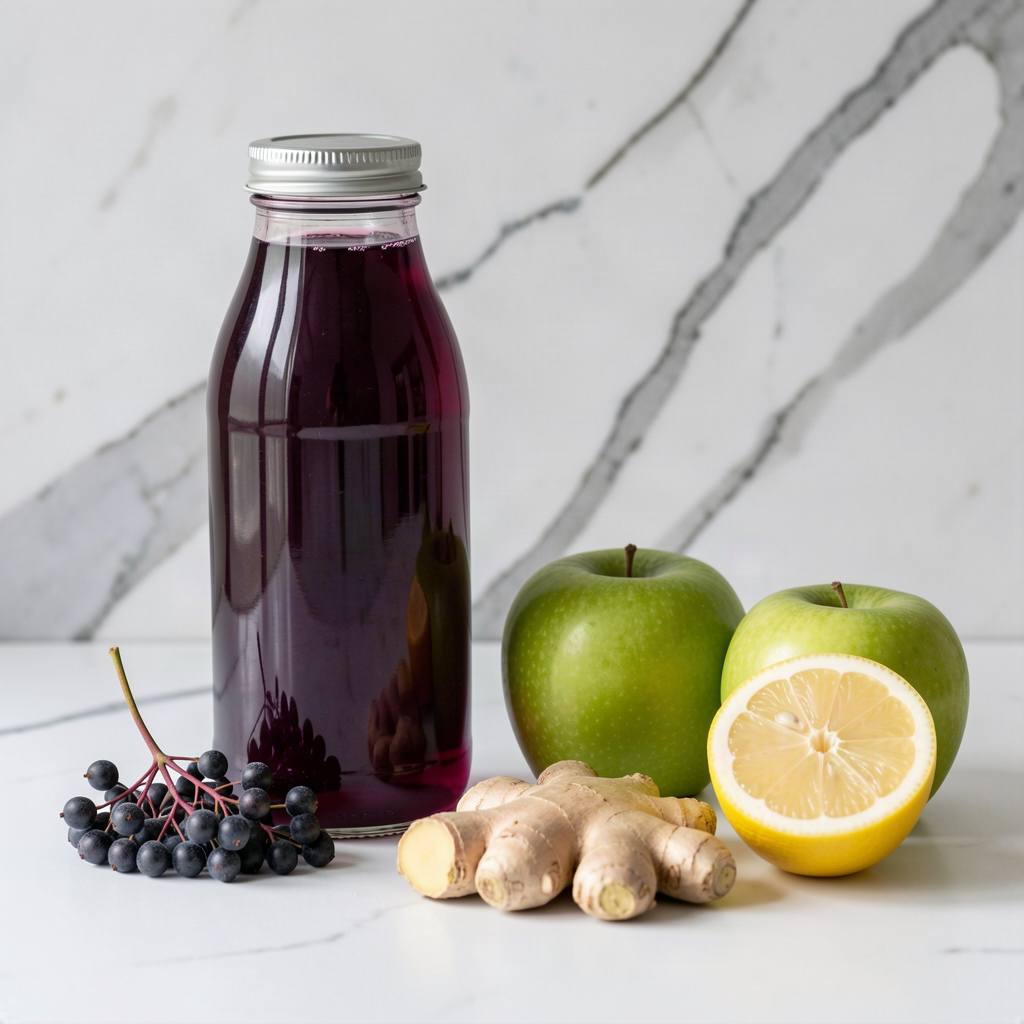
Every October I end up with a bag of elderberries in the freezer and a vague plan to do something useful with them. This is what I actually do with them. The berries get simmered for fifteen minutes, pressed through a sieve, then stirred into apple juice with a bit of ginger and lemon. It comes out dark purple and properly sharp, closer to blackcurrant cordial than to anything you buy in a carton, and it is the only juice on this site where I would stop you before you drink it.
Why these ingredients work
The elderberry is the reason this glass exists, so it is worth being straight about the evidence. The best known human trial is Tiralongo and colleagues in Nutrients in 2016, which followed 312 economy passengers flying out of Australia. It did not stop people catching colds: there were 17 cold episodes in the placebo group against 12 on the elderberry extract, a gap small enough to be chance. What it did do was make the colds that happened shorter and milder, 117 cold days against 57, with lower symptom scores. Two things matter about that. Everyone in the trial took a standardised, membrane-filtered commercial extract rather than a glass of home-pressed juice, so nobody knows what a glass of this does. And most of the elderberry literature uses commercial extracts, with a fair amount of it funded by the people selling them. So: an interesting berry, a plausible effect on how long a cold lasts, and nothing yet to say a home-pressed glass behaves like the extract.
Nutritionally the berry is modest and I would rather say so. It has around 36 mg of vitamin C per 100 g raw, which sounds good until you remember these berries get simmered for a quarter of an hour and heat degrades ascorbic acid, so this is not a reliable vitamin C drink. The colour is the interesting part: those deep purple anthocyanins are the main polyphenols in elderberry and they are what most of the laboratory work has looked at. One glass also carries about 450 mg of potassium, which is worth knowing if you have kidney disease or take an ACE inhibitor, an ARB or a potassium-sparing diuretic. Ask before making it a daily habit.
The apple is doing the sweetening. Elderberry on its own is sour with a slightly flat, dusty edge, and the usual fix in older recipes is a bag of sugar, which is how you end up with a cordial that tastes like the purple squash you drank as a child. Two sweet apples bring roughly 26 g of sugar a glass, which is already plenty, and no spoonful of anything else. Ginger earns its place twice: it lifts the sourness, and it is one of the better evidenced kitchen ingredients for nausea, with Viljoen and colleagues pulling the trials together in Nutrition Reviews in 2014. The lemon goes in last and only for balance. If the glass tastes flat, it wants more lemon rather than more sugar.
The one step you cannot skip
Raw elderberries are not safe to eat. They contain cyanogenic glycosides, in elderberry’s case mainly sambunigrin, which release hydrogen cyanide when the plant tissue is broken down. Oregon State University Extension is blunt about it: cook elderberries before eating them, every time, no exceptions. The reassuring half is that levels in ripe fruit are low. A 2021 laboratory analysis by Appenteng and colleagues measured 0.29 to 2.36 micrograms per millilitre in pressed juice, with the highest concentrations in the stems and the green berries rather than the ripe fruit. So the risk sits mainly in the parts you are already throwing away, and in being impatient. Strip the berries properly, bin every green one, simmer for a full fifteen minutes, and strain the pips out. Do not blitz raw berries and drink the result.
FAQ
Can I put elderberries through the juicer raw?
No. A juicer will happily turn raw elderberries into purple juice and that is exactly the problem, because nothing in that process gets hot enough to break the glycosides down. Cook them first, then press. The quickest route is to get the berries simmering, juice the apples, ginger and lemon while they cook, then push the cooked berries through a sieve. Twenty five minutes end to end, and most of that is waiting.
Does elderberry juice stop a cold?
It does not appear to stop you catching one. In the largest trial the number of cold episodes was not significantly different between the elderberry group and the placebo group. Where the difference showed up was in how long the colds lasted and how rough they were. That is a modest, believable effect from a concentrated extract, and a home-pressed glass is not the same thing. If you are unwell and it is not shifting, that is a conversation with your GP rather than a juice problem.
How long does it keep, and can I freeze it?
Four days in a sealed bottle in the fridge, three months frozen. Freeze it in ice cube trays if you do not want to defrost a whole bottle, and drop a couple of cubes into a glass of apple juice. The colour dulls a little after freezing, which is normal and harmless. Elderberries freeze well themselves, so if you get a glut in September, bag them in 300 g portions and make this in January when everyone in the house is coughing.
More immunity recipes: see the full Immunity collection.
Elderberry, Apple and Ginger Juice
Equipment
- Nut milk bag
Ingredients
For the elderberry press
- 300 g ripe elderberries stripped from the stalks, fresh or frozen
- 200 ml water
For the apple and ginger base
- 2 sweet apples about 300 g, cored but not peeled
- 1 small knob fresh root ginger about 15 g
- 0.5 unwaxed lemon
Instructions
Stovetop and juicer method (the safe way)
- Strip the berries first. Hold each cluster by the stalk and rake the berries off with a fork into a bowl. Pick out and throw away every green or unripe berry, every bit of stalk and every leaf. Only fully dark purple-black berries go in the pan.
- Tip the berries into a small saucepan with the 200 ml water. Bring to a gentle simmer, put a lid on and cook for 15 minutes, until the berries have collapsed and the liquid is deep purple. Do not skip this step and do not shortcut it. Raw elderberries contain cyanogenic glycosides and cooking is what breaks them down.
- While the berries cook, juice the apples, ginger and lemon. Run half an apple through the juicer last to push the ginger and lemon through with it, otherwise the ginger sits in the basket and half of it never reaches the glass.
- Spoon the cooked berries into a sieve set over a jug, or into a nut milk bag, and press them hard against the mesh until only skins and pips are left. You should end up with roughly 200 ml of dark juice.
- Stir the elderberry press into the apple juice. Taste it, add a squeeze more lemon if it needs lifting, then pour into bottles and chill.
Blender method (still cook the berries first)
- Strip and simmer the berries exactly as above, then leave them to cool for ten minutes with the lid off.
- Chop the apples, ginger and lemon and put them in the blender with the cooked berries and all of their cooking liquid.
- Blend on high for 60 seconds, until there are no lumps of apple left.
- Strain through a nut milk bag or a fine sieve, pressing the pulp with the back of a spoon, then chill. The blender version is thicker and cloudier than the juicer one, which is fine, but sieve it properly so no pips end up in the glass.