
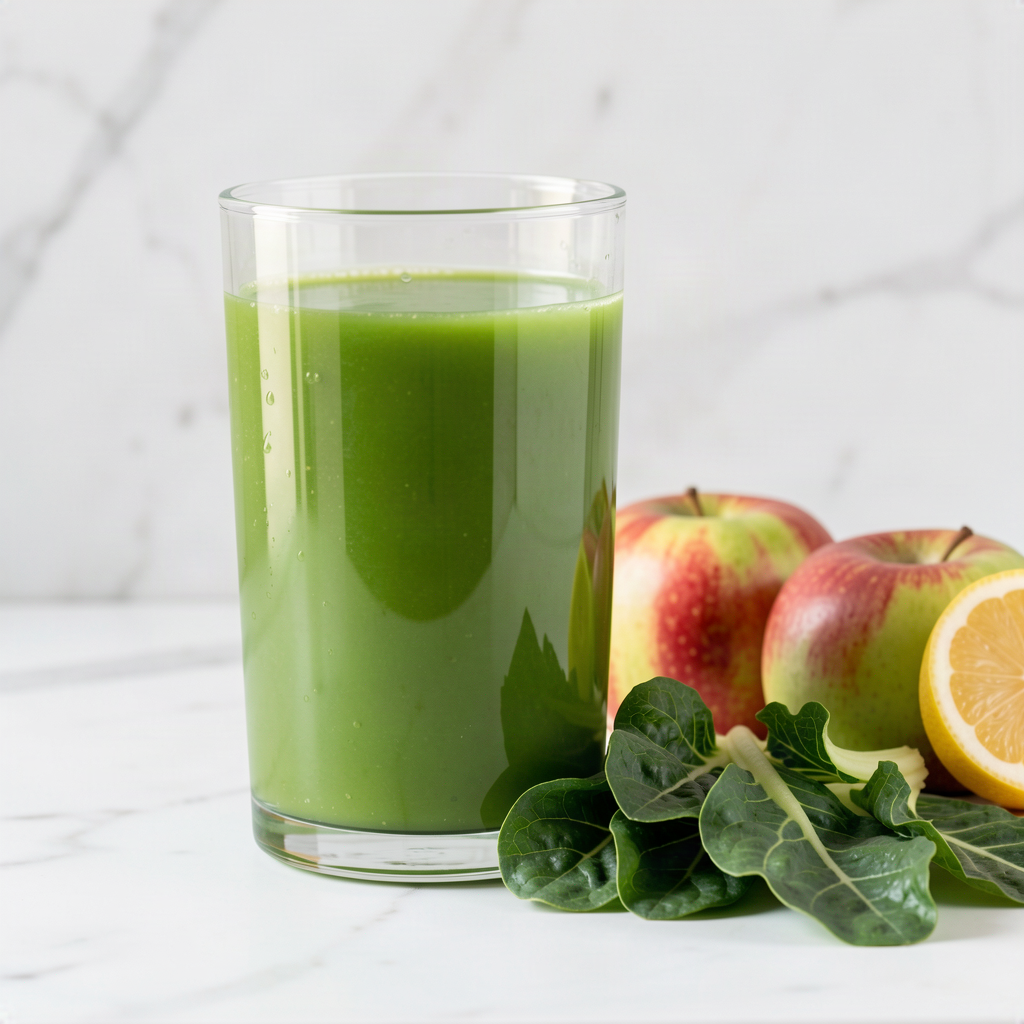
Green juice has a reputation problem, and honestly a lot of it has earned that reputation. Collard greens are the exception I keep coming back to. Raw, they are milder than kale, and a bunch of them costs less than a coffee. I started making this one after finding out that collards are one of the few greens where your body can actually get at the calcium, and it has stayed in the weekly rotation since.
Why these ingredients work
Collard greens are unusually good news on the mineral front. They are low in oxalates, the compound that binds calcium in spinach and stops you absorbing much of it, so the roughly 230mg of calcium in 100g of raw collards is far more use to you than the number on a spinach label suggests. They are also rich in vitamin K, which your body needs to keep calcium in your bones rather than letting it drift into the bloodstream. The apple is in here for taste as much as anything else: it smooths out the bitter edge of the greens and brings enough sweetness that you do not have to add sugar or honey. Lemon lifts the whole glass, and the vitamin C in it helps you take up the iron from the greens at the same time.
FAQ
What do collard greens taste like in a juice?
Milder than you would expect. Raw collards are faintly cabbagey and a little bitter, closer to spring greens than to kale. Once the apple and lemon are in, most people cannot pick the greens out at all. If yours still tastes sharp, the culprit is usually the stems, so make sure you cut those out before juicing.
Do I need a juicer to make this?
No. The blender method below gets you the same glass, you just need a nut milk bag or a fine sieve and a bit of patience squeezing the pulp. A proper juicer is faster and gives you a slightly clearer drink, but the taste and the nutrition are much the same either way. You can use kale or spring greens in place of the collards if that is what you have, spring greens being the closest match.
Is this juice actually good for your bones?
It gives you a fair amount of calcium, a lot of vitamin K and some vitamin C, and all three matter for bone. What it does not give you is vitamin D, which is the nutrient most people in the UK are short of between October and March, and that comes from oily fish, eggs or a supplement rather than a juice. One glass also covers well over twice the vitamin K an adult needs in a day, so if you take warfarin or another blood thinner, keep your intake steady week to week and have a word with your GP before you drink this daily.
More greens for bones and teeth: see the full STRUCTURE collection.

Collard Greens, Apple and Lemon Juice
Equipment
- Nut milk bag
Ingredients
Juice
- 4 large collard green leaves about 120g, thick central stems removed
- 2 sweet apples about 300g, Braeburn or Gala, cored and cut into wedges
- 0.5 lemon about 30g, peeled
Instructions
Juicer method
- Rinse the collard leaves and shake them dry. Cut the thick central stem out of each leaf and trim the bottom of the stalk. Those stems are fibrous and they turn the juice bitter, so they go in the compost.
- Core the apples and cut them into wedges that fit your juicer's feed chute. Keep the skin on, that is where a good deal of the flavour and the colour sits.
- Peel the half lemon and cut it into two or three pieces.
- Feed the collard leaves through first, then the apple, then the lemon. On a slow juicer, alternate a leaf with a piece of apple so the greens do not clog the pulp outlet.
- Stir the juice and drink it while it is fresh, or pour it into a sealed glass bottle and keep it in the fridge for up to 24 hours. It separates as it sits, so give the bottle a shake before you pour.
Blender method
- Chop the collard leaves, the apple and the peeled lemon into small pieces and put them in the blender with 200ml cold water.
- Blend on high for a full minute until there are no big green flecks of leaf left.
- Tip the lot through a nut milk bag or a fine sieve set over a jug, then squeeze the pulp hard to get the last of the liquid out. You should end up with roughly 500ml of juice.
- Chill it for ten minutes before you drink it, it tastes better cold.