

Globe artichokes are the strangest thing in the vegetable aisle and I buy them mostly for that reason. You pull one apart leaf by leaf to get at the heart, and if you are anything like me you have thrown away more of them than you have eaten. This is the recipe that sorted that out for me. The hearts go through the juicer with two apples, half a cucumber and a lemon, and what comes out is a mild green glass with a proper bitter edge, closer to an aperitif than a smoothie. I have it before a big dinner rather than with breakfast, and there is one caution below that I would not leave out.
Why these ingredients work
The artichoke is what makes this different from every other green juice on the site. Its bitterness comes from chlorogenic acid and cynarin, the same family of compounds that give radicchio and chicory their edge, and unlike most of the vegetable’s fibre they dissolve in the liquid, so they are still in the glass after you strain it. Those compounds are the reason artichoke has such a long history as a vegetable to eat before a meal, and the reason it is a choleretic, which simply means it encourages the liver to release bile into the gut. That is a digestive effect, not a cleanse. Your liver and kidneys filter what you drink whether or not there is a bitter vegetable in it.
Two apples and half a cucumber carry the flavour and give the glass some volume, because trimmed artichoke hearts give surprisingly little juice for the amount of work. The lemon does two jobs: it lifts a drink that is otherwise rather savoury, and it slows the browning, because cut artichoke oxidises quickly and a glass without lemon turns a dull brown within the hour.
The research is thin and I would rather say that than dress it up. The one human trial that used artichoke juice itself (Lupattelli and colleagues, Life Sciences, 2004) gave 18 people with mildly raised cholesterol 20 ml a day of frozen juice pressed from artichoke leaves for six weeks, and their LDL cholesterol and their blood vessel function both improved slightly. Genuinely interesting, but it was small, it was not a properly randomised trial, the control group’s cholesterol fell too, and it was a concentrated leaf juice rather than a glass of hearts. The Cochrane review of artichoke leaf extract for cholesterol concluded the evidence was not convincing. Where artichoke leaf extract does have reasonable support is indigestion: a six week double blind trial (Holtmann, 2003) found it beat placebo in people with functional dyspepsia. So drink this because it tastes good and makes a nice start to a meal, not because it will do anything dramatic.
One real caution before you make it: because artichoke encourages bile flow, anyone with gallstones or a blocked bile duct should skip this one and ask their GP or pharmacist first. Artichokes are also a windy food for plenty of people, so start with a small glass.
Frequently asked questions
Does artichoke juice detox your liver?
No, and it is the claim I would ignore. Your liver and kidneys do the filtering and no drink changes that. What artichoke genuinely does is encourage bile flow, which is a digestive effect rather than a cleanse, and the only trial of artichoke juice that exists looked at cholesterol and blood vessel function rather than anything you could call detoxing. Cutting back on alcohol and eating more vegetables will do far more for your liver than a glass of juice, and if you have an actual liver condition you want your doctor, not a recipe page.
Can you juice the whole artichoke?
You can, but you will not want to. The outer leaves are tough and seriously bitter, and a home juicer fights them, which is why this recipe trims down to the hearts and the stems. The one part you must leave out is the fuzzy choke in the middle, which is inedible and not pleasant. If you have a strong masticating juicer and you fancy trying the leaves, expect a much darker and more medicinal glass and use plenty of apple to carry it.
Why does water taste sweet after eating artichoke?
That one is real and it has a name. Artichoke contains chlorogenic acid salts and cynarin, which temporarily damp down the sweet receptors on your tongue, so when the artichoke is washed away by the next mouthful everything tastes sweeter than it should. It was first described in Science in 1972 by Linda Bartoshuk and her colleagues. It is also why an artichoke can make a glass of wine taste odd, and it is a good reason this juice needs no sweetener beyond the apple.
More digestive drinks like this: see the full Detox collection.
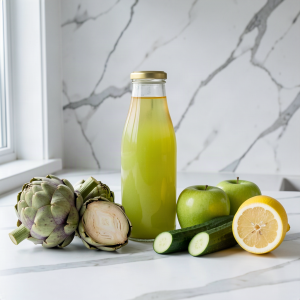
Artichoke, Apple and Cucumber Juice
Equipment
- 1 Juicer apple and cucumber first so the basket is wet
- 1 High-speed blender for the blender method
- 1 Nut milk bag or a fine sieve
- 1 Airtight glass bottles for the rest of the day
Ingredients
You'll need
- 2 globe artichokes about 700 g in total, before trimming, down to the hearts and stems
- 2 sweet apples about 300 g, cored, green or red
- 1/2 cucumber about 150 g
- 1/2 unwaxed lemon peeled
Instructions
Juicer method
- Trim the artichokes down to the hearts. Pull off every outer leaf, slice the top third off, cut the stem back to about 2 cm, then halve each artichoke lengthways and scoop the fuzzy choke out of the middle with a teaspoon. What you want left is the pale heart and the trimmed stem, and nothing else.
- Quarter the apples and cut out the cores, cut the cucumber into chunks that fit your feed chute, and peel the half lemon.
- Juice the apples and the cucumber first so the basket is already wet, then feed the artichoke hearts through slowly, a piece at a time, and finish with the lemon.
- Stir it, then pour it straight into a glass or a bottle you can seal. Add the lemon straight away and drink it the same day, because artichoke juice browns quickly once it meets the air.
Blender method
- Trim the artichokes down to the hearts as above, then cut the hearts into small pieces, no bigger than a thumbnail, because they are firm and a blender will just spin around a big chunk.
- Core and roughly chop the apples, chunk the cucumber and peel the lemon, then put everything into the blender with 150 ml of cold water.
- Blend on high for 60 seconds until there are no lumps left, then pour through a nut milk bag or a fine sieve set over a jug and press the pulp hard with the back of a spoon.
- Serve straight away, or bottle it and keep it in the fridge for the rest of the day. It does separate as it sits, so give the bottle a shake.