
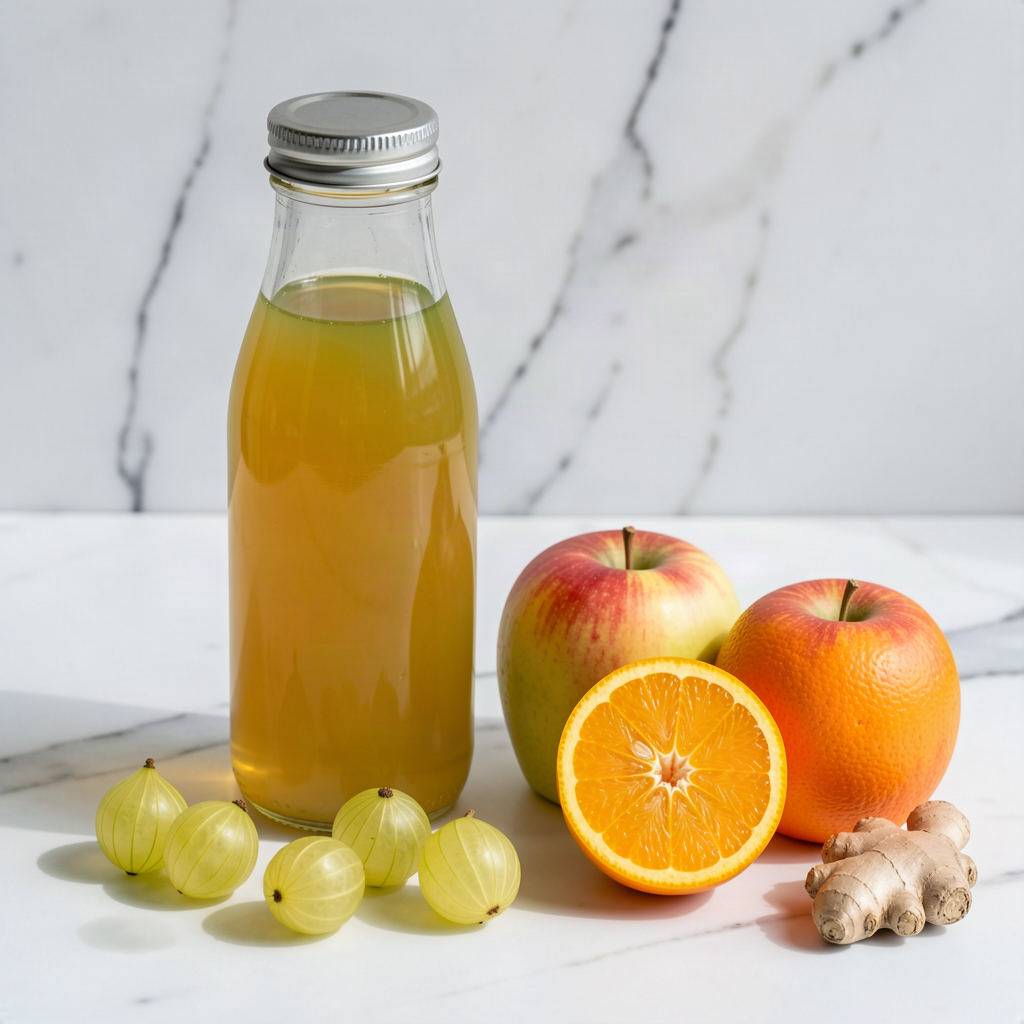
I keep a bag of amla in the freezer now. They turn up fresh at the Asian grocer I use from late autumn, small pale green berries that look like oversized gooseberries with faint ridges down the side, and on their own they are almost aggressively sour. Four of them is plenty. Softened with two sweet apples and a whole orange they make a pale golden-green juice that is sharp and clean rather than punishing, and it carries more vitamin C in one glass than most of us get in a whole day. This is what I make when I want something with an edge to it instead of another sweet apple juice.
Why these ingredients work
Amla is one of the richest natural sources of vitamin C there is. Published figures for the fresh fruit run from roughly 190 to 720 mg per 100 g depending on the cultivar, which is somewhere between four and fifteen times what you get from an orange. Amla is also extremely high in tannins, and it holds on to its vitamin C far better than most fruit when it is heated or stored, which is usually put down to those tannins. That is a reason to juice amla raw and leave out the long simmering and the cup of sugar that most amla recipes start with, rather than a health claim in itself. The apple and the orange are doing two jobs here: they bring the sweetness and the volume that make the berries drinkable, and the orange adds its own vitamin C and folate. The ginger is for the finish, a warm note underneath the sourness so the whole glass does not taste flat. What it will not do is stop you catching a cold. The Cochrane reviews found that regular vitamin C does not prevent colds in healthy adults, it can only shorten one slightly, so drink this because it is a genuinely good habit and a far better glass than a fizzy drink.
FAQ
How many amla should I use in a juice?
Four small berries per two glasses is the sweet spot. Amla vary a lot in size and in how sour they are, so if yours are large, or you are new to the taste, start with two or three and add another apple to soften it. There is no need to peel them, and in a juicer there is no need to take the stone out either, the machine deals with both. In a blender you do need to cut the stone out first.
Can I use frozen amla instead of fresh?
Yes. Frozen amla work well, thaw them first and use them straight away, and they are the sensible option outside the fresh season, which in the UK runs roughly from late autumn into winter. Dried amla and amla powder are a different thing entirely: they taste far more concentrated and medicinal, they do not juice, and the vitamin C is not the same, so keep those for smoothies or for stirring into something else.
Is amla juice safe to drink every day?
For most people a glass a day is fine, and that is close to how the fruit is eaten in India, but it is very sour and high in tannins, so it is better with or after food than on an empty stomach, particularly if you are prone to acid or reflux. If you are anaemic, remember that tannins hold back iron absorption, so do not drink it alongside your main iron-rich meal. Amla is food, not medicine, and it should never stand in for anything your GP has prescribed.
More immunity recipes: see the full Immunity collection.
Amla, Apple and Orange Juice
Equipment
- Nut milk bag
Ingredients
Ingredients
- 4 fresh amla (Indian gooseberries), about 50 g, stalks pulled off
- 2 sweet apples, about 300 g, cored and quartered
- 1 large orange, about 200 g, peeled and quartered
- 2 cm fresh ginger, peeled optional
Instructions
Juicer method
- Wash the amla and pull off the little stalks. Leave the berries whole, the juicer deals with the stone inside them.
- Core and quarter the apples, peel and quarter the orange, and peel the ginger.
- Feed the amla through first, on their own, so you can taste exactly how sour they are before they disappear into the glass. Then the apple, then the orange, then the ginger last. Alternate a firm piece with a wet one so the pulp keeps moving and does not clog the basket.
- Stir and taste. If it is sharper than you want, add another apple rather than sugar. Drink it straight away, or seal it in a bottle and keep it in the fridge for up to two days.
Blender method
- Cut the amla in half and flick out the stones with the tip of a knife, then chop the flesh roughly. Core and chop the apples, peel and segment the orange, and peel the ginger. Amla are very fibrous, so keep the pieces small and add a splash of cold water to get the blades moving.
- Blend on high for about a minute, until the pulp is as fine as you can get it.
- Pour it through a nut milk bag or a very fine sieve over a jug and squeeze hard. Amla pulp holds on to a lot of juice, so take your time and press it properly rather than binning the good stuff.
- Serve over ice or straight from the fridge. It will settle a little as it sits, just stir it back together.