
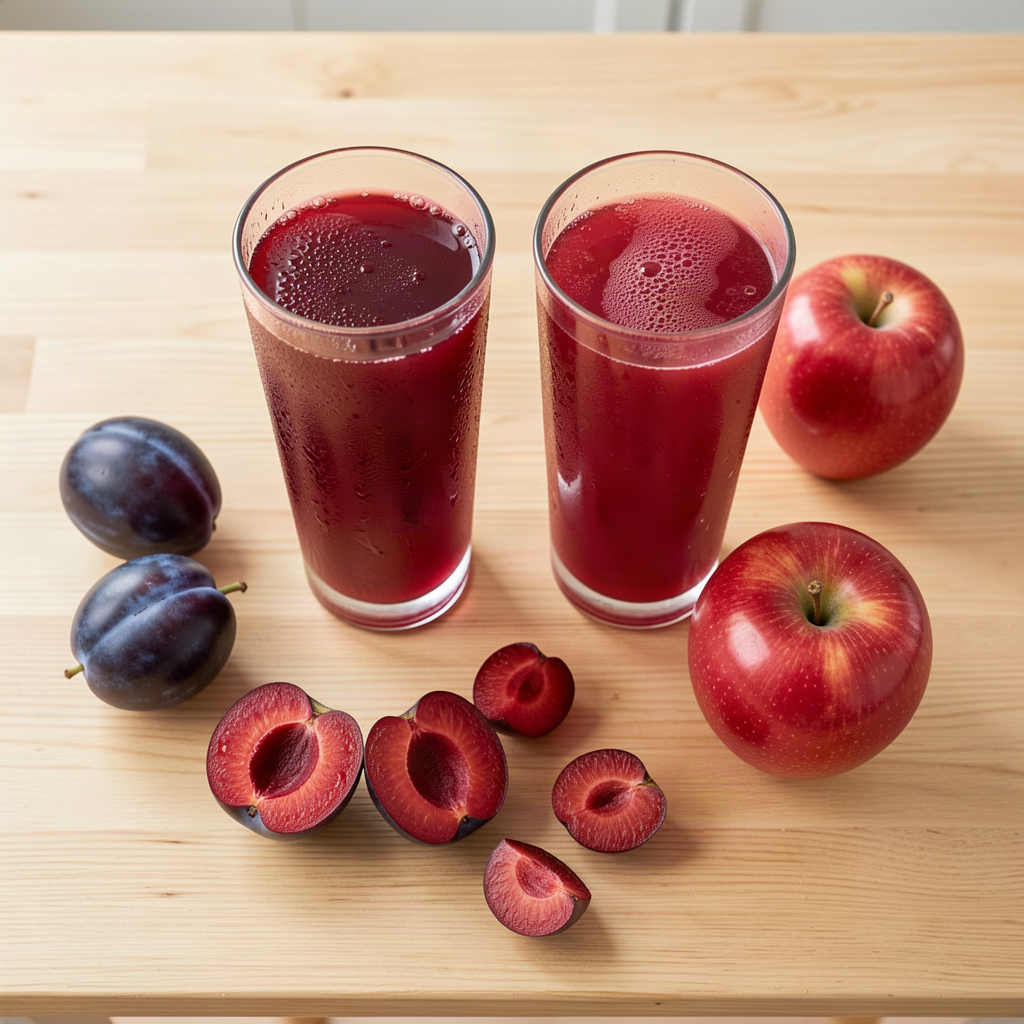
For about three weeks every September, the box of Victoria plums at the greengrocer’s is the best thing in the shop. The rest of the year I walk straight past them, and then suddenly they’re here, soft and dusky and smelling of jam, and I buy far too many. Some go in a crumble. A lot of them go in this juice, which is the fastest way I know to use up a bowl of plums before they tip over the edge. Sweet apple stretches them further and rounds off their sharp edge, and the two of them make a glass the colour of red wine that tastes like autumn in a way no shop-bought juice ever has.
It’s also, handily, one of the gentlest juices on my stomach. Plums carry sorbitol, the same naturally occurring compound that gives prune juice its gentle effect, plus real fibre in the skin. I’m not going to oversell it: this is a nice thing to drink when you feel a bit sluggish, not a medicine. But it’s one of the few juices I reach for when my digestion needs a quiet day.
Why these ingredients work
Plums are the whole point, so buy the ripest you can find. Six average plums give you around 350g of fruit: roughly 1.4g of fibre per 100g, about 9mg of vitamin C per 100g, and natural sugar at around 9 to 10g per 100g. More usefully for digestion, plums are one of the few fruits with a meaningful amount of sorbitol, a sugar alcohol that draws water into the bowel and helps things move along. It’s the same compound that gives prune juice its reputation; fresh plums just carry it in smaller, gentler doses.
Apples are the quiet half. They’re mostly there for sweetness and body, but they bring pectin, a soluble fibre that feeds the good bacteria in your gut, and they contain a little sorbitol of their own. Between the two fruits, a glass of this comes to about 26g of natural sugar, which is comparable to a glass of orange juice, so I treat it as juice rather than water. Most of the fibre stays in the pulp, so if you want the full digestive benefit, don’t strain the blender version too hard and stir a spoonful of pulp back in.
FAQ
Do I need to peel the plums?
No. The skin is where the colour, most of the fibre and a lot of the flavour live, and it juices perfectly well. Just take the stones out first, because they’re rock hard and will blunt your blades. If you’re using the blender method and the skin leaves a slightly grainy finish, you can peel the plums beforehand, but you lose some of that deep ruby colour when you do.
What’s the difference between plum juice and prune juice?
Prunes are just dried plums. Taking the water out concentrates everything, which is why prune juice has a stronger effect on the bowel. Fresh plum juice is much gentler, which suits most people fine, and it tastes brighter than prune juice, without that heavy syrupy note. If you already use prune juice to keep things moving, this fresh version makes a lighter everyday alternative rather than a straight swap.
Can plum juice help with constipation?
It can help nudge things along, but it isn’t a laxative and I wouldn’t use it like one. The sorbitol and the fibre in the skin draw water into the bowel, which is exactly why prune juice is such a classic, and a glass of this fresh version is a gentler option in the same family. Start with one glass and see how you get on: too much sorbitol in one go can cause bloating or cramps, and anyone with IBS might find stone fruit triggers them. If constipation is a regular problem rather than the odd sluggish day, that’s worth a conversation with your GP, not another juice.
More digestion recipes: see the full Digestion collection.
Plum Apple Juice
Equipment
- 1 Juicer masticating or centrifugal
- 1 High-speed blender for the blender method
- 1 Nut milk bag or fine-mesh sieve to strain the blender version
- 2 Airtight glass bottles for storing
- 1 Budget cold press juicer a great value alternative
- 1 Budget blender a great value alternative
Ingredients
Juice base
- 6 ripe plums Victoria or any sweet dark-skinned plum, about 350g. They should give slightly when you squeeze them; halved and stoned
- 2 sweet apples about 300g, quartered. Gala or Jazz work well, the sweeter the better so nothing else needs adding
- 100 ml cold water only if using the blender method
Instructions
Juicer method
- Halve the plums, twist the halves apart and pick out the stones. Leave the skin on: it carries the colour and most of the fibre, and it juices without complaint.
- Quarter the apples. I do not bother coring or peeling them, just cut out any bruised or brown bits.
- Feed the fruit through the juicer, alternating a few plum halves with a wedge of apple. Plums are soft, so if things stall, push an apple wedge through behind them rather than leaning on the plunger.
- Stir the juice well, pour into two glasses and drink straight away. Chill the fruit for an hour beforehand if you want it cold, rather than adding ice and watering it down.
Blender method
- Prep the fruit the same way: plums halved and stoned, apples quartered.
- Tip both into a blender with the cold water and blitz on high for 45 to 60 seconds, until smooth.
- Strain through a nut milk bag or a fine-mesh sieve, squeezing the bag to get every last drop out. The pulp is mostly skin and fibre, and a spoonful stirred back in gives the juice more body.
- Pour into two glasses and drink within the hour, or chill in an airtight bottle and give it a good shake before you pour.