
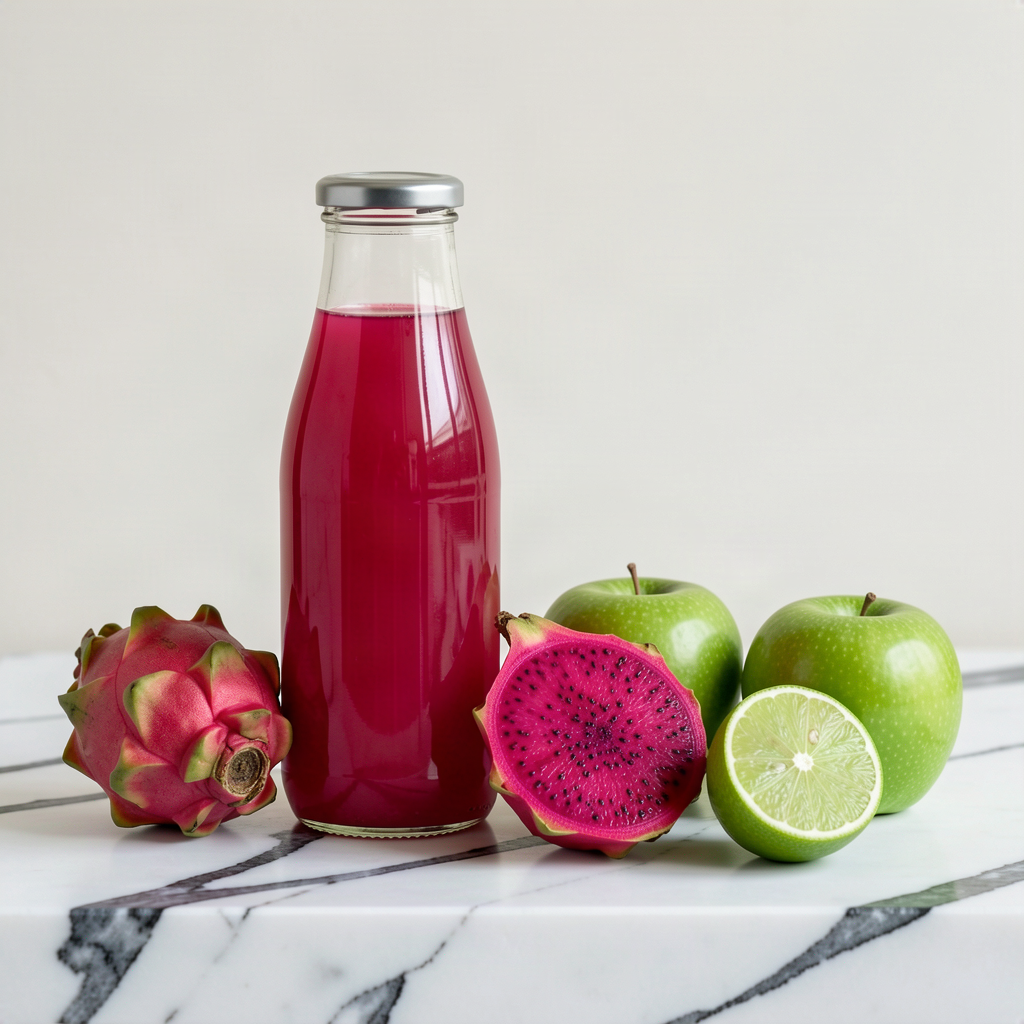
I bought my first dragon fruit out of pure curiosity, cut it open expecting something extraordinary, and got a mouthful of not very much. That is the thing nobody tells you about pitaya. It looks spectacular, all hot pink skin and green scales, and then it tastes like a very mild pear with a bit of kiwi in the background. Blend it with a couple of sweet apples and a lime, though, and it stops being a disappointment. You end up with a drink that tastes like proper fruit juice and a colour that looks like it came out of a cocktail bar. I make mine with red-fleshed fruit, because the white sort gives you a pale, apologetic pink that does not sell itself.
Why these ingredients work
Dragon fruit is about 87 per cent water, which is why the glass feels light rather than syrupy. The part worth knowing about is its oligosaccharides, a group of non-digestible carbohydrates in the flesh. Because they are dissolved rather than suspended in the pulp, they stay in the glass after you strain it, which is the opposite of what happens to most of the fibre in a juice. Wichienchot and colleagues measured them in pitaya flesh and found they fed bifidobacteria and lactobacilli in the laboratory (Food Chemistry, 2010, 120(3), 850-857). Say that plainly for what it is: petri dish work, not a trial showing a glass of juice changes anything in a person. It is a genuinely interesting reason to drink it, not a cure for anything.
Two things get oversold, so I will knock them down here. Dragon fruit is not a vitamin C fruit. It carries roughly 3 mg per 100 g, which is less than an apple and nowhere near an orange, so the vitamin C in this glass comes from the apple and the lime, and that is about 18 mg, under half your daily 40 mg. And it does not detox anything, whatever the smoothie bowl pages say. What it does have going for it, particularly the red-fleshed sort, is a little more fibre and minerals such as magnesium than the white sort, according to a 2024 review of the fruit’s nutrition and pharmacology (Chen et al., PMC11643819).
The apples do the heavy lifting on flavour, which is no bad thing. They bring the sweetness and the body that pitaya lacks, plus enough acidity to stop the drink tasting like diluted water, and their skin carries colour into the glass. The lime goes in last and only a little, because pitaya is delicate and lime will walk all over it. A squeeze lifts the whole drink. Two squeezes and you have made lime juice with a pink tint.
FAQ
Does dragon fruit juice turn your pee pink?
Sometimes, yes, and it is nothing to worry about. The magenta comes from betacyanins, the same pigment family that gives beetroot its colour, and some people do not break them down completely, so they pass through and tint urine and stool pink for a few hours. It is the phenomenon known as beeturia, and the medical literature describes it as harmless (Sauder and colleagues, StatPearls, 2023). It only happens with red or magenta-fleshed fruit, never the white sort, and if you are the sort of person who forgets what they drank yesterday it is worth knowing before it gives you a fright.
Is dragon fruit juice actually good for your gut?
The honest version is that it is promising rather than proven. The oligosaccharides are real and they are the sort of thing gut bacteria ferment, and unlike most of the fibre in a juice they survive straining because they are dissolved. But the evidence is laboratory work and small studies, not trials in people drinking pitaya juice, and a glass is not a probiotic. Bear in mind too that those same fermentable carbohydrates can produce wind, so if you have IBS or a sensitive gut, start with one small glass rather than a pint and see how you get on. Eating the fruit whole will always give you more fibre than the juice, because the pulp does not go in the bin.
Can you juice dragon fruit in a normal juicer?
You can, but it needs help. The flesh is soft and wet with very little structure, so on its own it smears across the basket and clogs the mesh. Juice the apples first to wet everything, then alternate the pitaya with the apple so each chunk of soft flesh has something firm to push against. A blender is honestly easier, and a light strain through a nut milk bag gives you a cleaner drink than the juicer does. Pick fruit that gives slightly when you press it, with dry scales rather than slimy ones, and use it within a couple of days of buying it. Overripe pitaya tastes fermented, which is not the flavour you are after.
More digestion recipes: see the full Digestion collection.
Dragon Fruit, Apple and Lime Juice
Equipment
Ingredients
For the juice
- 2 dragon fruit (pitaya) red-fleshed if you can find them, about 700 g whole for roughly 450 g of flesh
- 2 sweet apples about 300 g, Gala, Jazz or Braeburn
- 1 lime unwaxed, juice only
For the blender method
- 100 ml cold water the blades will not catch the flesh without it
Instructions
Juicer method
- Halve the dragon fruit lengthways and scoop the flesh out with a spoon, leaving the skin behind. Cut it into rough chunks. There is no need to be neat about it.
- Quarter and core the apples but leave the skin on, because that is where a good deal of the colour and flavour sits.
- Juice the apples first. Two apples wet the basket and give the dragon fruit something to travel through, otherwise soft pitaya flesh just smears across a dry mesh and clogs it.
- Alternate the dragon fruit chunks with the rest of the apple, then add the lime last so the acid runs through the mesh rather than sitting in the pulp.
- Stir once and taste. If it seems flat, squeeze in a little more lime. Drink it straight away, or bottle it and keep it in the fridge for no more than a day.
Blender method
- Scoop the dragon fruit flesh into the blender with the apples, cored and roughly chopped but not peeled.
- Add 100 ml of cold water. Without it the blades simply push the flesh around the jug and nothing happens.
- Blend for 30 to 40 seconds until smooth. Do not leave it running for a minute, because the tiny black seeds break up and the drink turns gritty.
- Strain through a nut milk bag or a fine sieve, pressing gently with the back of a spoon. A light press keeps some body, a hard one gives you a thinner, clearer drink.
- Stir the lime juice in at the end rather than blending it, so the sharpness stays bright rather than muddy.