
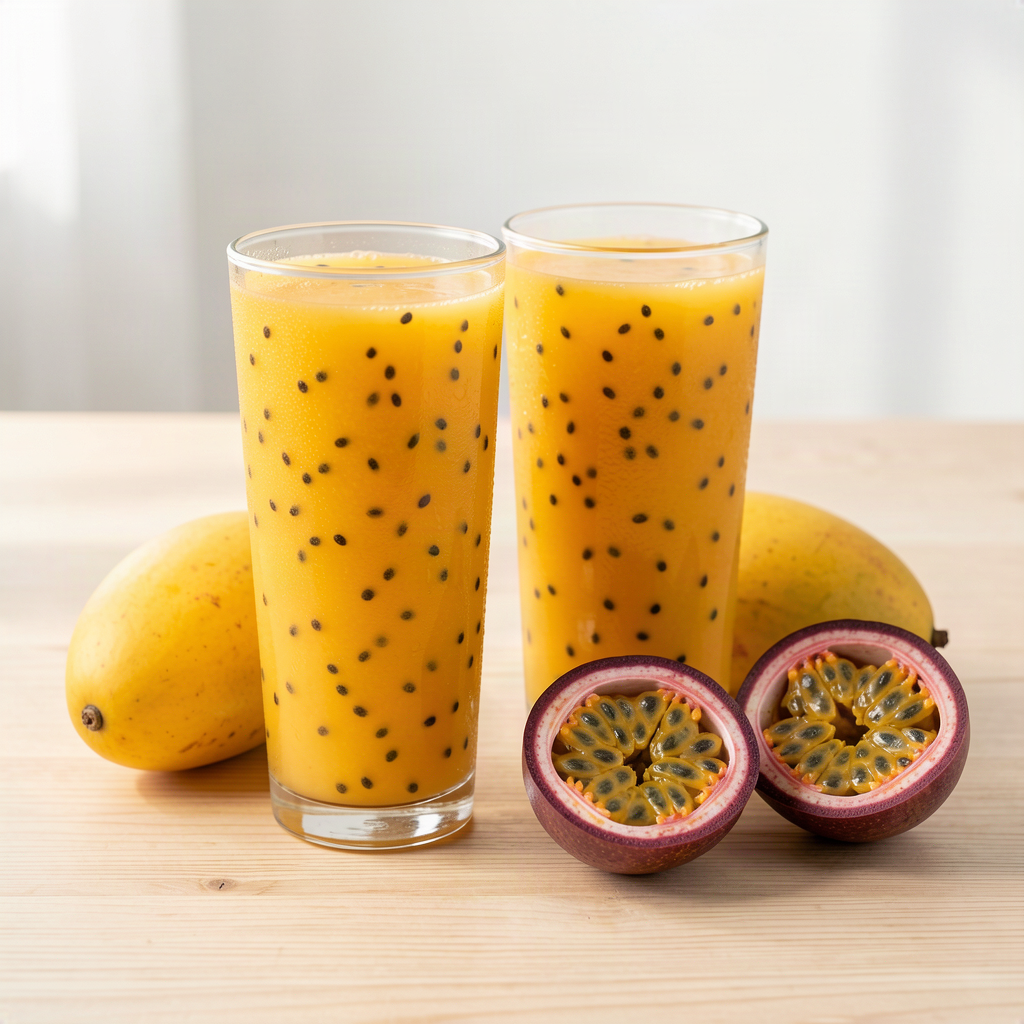
I ignored passion fruit for years. A fruit you have to scoop out with a spoon, seeds and all, felt like too much faff for the payoff. Then one hot afternoon I spooned the pulp over a bowl of chopped mango on a whim and something clicked. That sharp, perfumed tang is exactly what sweet mango is missing, and it turns an ordinary glass of juice into something that tastes like it came from a beach bar. It’s been a regular in my kitchen ever since, and it’s the first thing I make when the autumn colds start doing the rounds.
This one is two fruits and nothing else. No added sugar, no water unless you’re blending, nothing to hide behind. If passion fruit has always looked like too much effort, this is the friendliest way in: the mango carries the sweetness and the passion fruit just adds its sharp, flowery edge on top.
Why these ingredients work
Mango is the sweet half and it earns its place with more than sugar. A ripe mango carries roughly 35mg of vitamin C per 100g of flesh, and it’s one of the few fruits that brings beta-carotene too, the orange pigment the body turns into vitamin A for your skin and the lining of your gut.
Passion fruit is the surprise. Four of them give you around 20mg of vitamin C, some beta-carotene of their own, and seeds that are mostly fibre, which is the part of the fruit that usually ends up in the bin. Between the two, a glass of this comes to about 80mg of vitamin C, double the 40mg daily guideline in the UK. The body can’t store vitamin C, so it wants a regular top-up rather than one big hit at the weekend.
I’ll be straight about what this isn’t. The trials on vitamin C megadoses and colds came back underwhelming, and no juice is a medicine. What the evidence does support is immune cells not working as well without vitamin C, and getting it from whole fruit with the fibre still attached beats a supplement for most people. That’s the real reason this glass exists in my kitchen from September onwards.
FAQ
Can I leave the passion fruit seeds in?
Yes, and I usually do. The seeds are edible and add a bit of crunch plus real fibre, which is the part of the fruit most juices throw away. If you’d rather have it smooth, push the pulp through a fine sieve before blending, or strain the finished juice through a nut milk bag. You lose some fibre but the flavour is the same.
Can I use frozen mango or bottled passion fruit pulp?
Frozen mango is fine and often better value outside mango season. Thaw it first and tip any juice that runs out into the blender or juicer along with the fruit. For passion fruit, jars of pulp work well as long as the label says unsweetened. Some brands pack the pulp in sugar syrup and that makes the juice noticeably sweeter, so check before you buy.
Is mango passion fruit juice high in sugar?
Honestly, yes. There’s around 30g of natural sugar in a glass, which is roughly what you’d get from a can of full-sugar cola, except here it arrives with vitamin C and fibre. I treat this as a treat rather than a thirst-quencher and I wouldn’t have it every day, and it’s worth having alongside food if you’re watching your blood sugar. It’s not as sweet as a mango and orange juice, because passion fruit carries less sugar than orange, but it’s still a sweet drink rather than a thirst-quencher.
More immunity recipes: see the full Immunity collection.
Mango Passion Fruit Juice
Equipment
- 1 Juicer masticating or centrifugal
- 1 High-speed blender for the blender method
- 1 Nut milk bag or fine-mesh sieve to strain the blender version
- 2 Airtight glass bottles for storing
- 1 Budget cold press juicer a great value alternative
- 1 Budget blender a great value alternative
Ingredients
Juice base
- 2 ripe mangoes peeled and stoned, about 400g of flesh; squeeze the stones over the bowl first, they hold more juice than you'd think
- 4 passion fruits halved, with the pulp and seeds scooped out, about 70g of pulp
- 100 ml cold water only if using the blender method
Instructions
Juicer method
- Peel the mangoes and slice the flesh off the stone in big chunks. Squeeze the stones over the bowl, then pick out any stringy bits.
- Halve the passion fruits and scoop the pulp and seeds into a small bowl.
- Feed the mango chunks through the juicer a few at a time. Mango is soft, so if it stalls, push it through with a spoonful of passion fruit pulp rather than ramping the plunger.
- Stir the passion fruit pulp through the mango juice, seeds and all. Taste, add a splash of cold water if you want it thinner, and pour into two glasses over ice.
Blender method
- Prep the fruit the same way: mango flesh in chunks, passion fruit pulp scooped out.
- Tip the mango, passion fruit pulp and cold water into a high-speed blender and blend on high for 45 to 60 seconds, until smooth.
- Pour through a nut milk bag or fine sieve if you want it seed-free, squeezing out as much as you can. Leave it unstrained if you like the seeds, they're edible.
- Taste, thin with a splash more water if you need to, and serve over ice.