
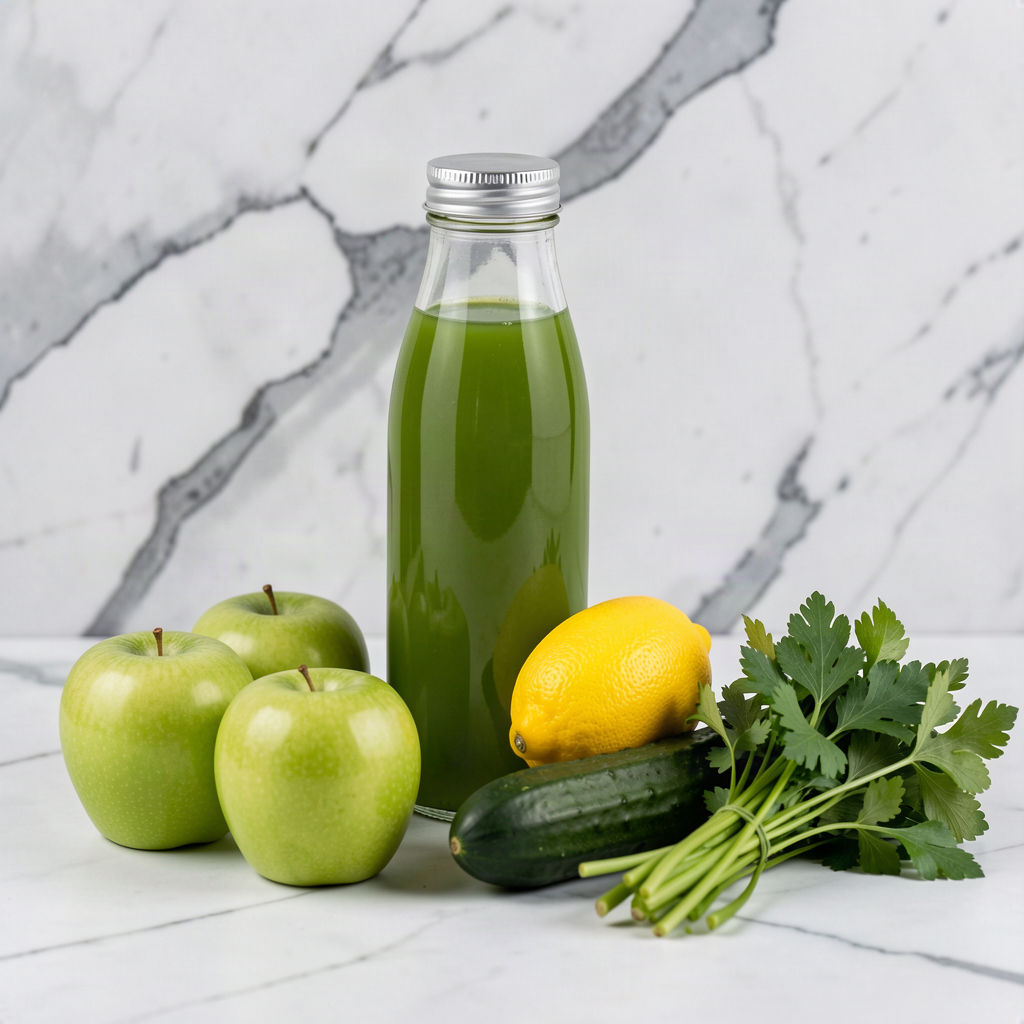
Parsley gets treated as a garnish, and online it gets treated as a kidney tonic that will flush you out. Neither does it justice. By a distance it is the richest everyday source of vitamin K there is, and vitamin K is one of the few things a glass of green juice can genuinely deliver in a meaningful amount. I keep this one in the rotation when I want something savoury and green rather than sweet. The apple does the sweetening, the cucumber keeps it light, and the lemon stops the parsley tasting flat.
Why these ingredients work
Parsley is the reason this juice exists. Raw parsley carries around 1640 micrograms of vitamin K per 100 grams, well ahead of kale, spinach or any of the greens usually sold on the strength of it, and vitamin K is what lets your body activate osteocalcin, the protein that pulls calcium into bone. Parsley is also unusually high in vitamin C for a leaf, more than twice an orange weight for weight, and it brings a useful amount of folate and iron. The apple supplies the sweetness and a little soluble fibre that ends up in the pulp you strain out. The cucumber adds water and makes the glass easy to drink rather than a bitter shot. The lemon lifts the flavour, and its vitamin C helps you take up the iron.
One honest caveat before the recipe. Parsley is high in oxalate, and a lot of its calcium is bound up as calcium oxalate, so it is not a bone drink because of the calcium. It is a bone drink because of the vitamin K.
FAQ
Is parsley juice good for your bones?
Vitamin K is essential for bone health and parsley is one of the very richest sources of it, so a parsley juice is a sensible way to get vitamin K. It is not a calcium drink though. Parsley contains calcium, but much of it is bound as oxalate, which your body absorbs poorly, so give the credit to the vitamin K rather than the calcium.
Does parsley juice flush your kidneys or dissolve stones?
That one is repeated everywhere and it is not backed by good evidence. Parsley has a long traditional use as a mild diuretic and there is laboratory work looking at how it affects crystal formation, but there is no solid human trial showing that a glass of parsley juice cleans your kidneys. Parsley is also high in oxalate, which is the compound most kidney stones are made of, so if you have had stones, keep it to an occasional small glass and check with your GP.
Can you juice parsley stalks?
Yes. The stalks juice perfectly well and carry plenty of the flavour, so there is no need to strip a whole bunch down to leaves. Just wash the bunch properly first, because grit settles in the stems and you do not want it in the glass.
More structure recipes: see the full Structure collection.
Parsley, Apple and Cucumber Juice
Equipment
- Nut milk bag
Ingredients
For the juice
- 1 large bunch flat-leaf parsley about 50 g, stalks and all
- 2 sweet apples cored and quartered (about 300 g)
- 1 cucumber roughly chopped (about 300 g)
- 1/2 unwaxed lemon peel left on
Instructions
Juicer method
- Wash the parsley properly, especially down the stems where grit likes to settle, and give it a shake. There is no need to pick the leaves off, the stalks juice fine.
- Core and quarter the apples and chop the cucumber into chunks that will fit your feed chute. Leave the peel on the lemon half and cut it into two pieces.
- Feed everything through the juicer, leading with a piece of cucumber so the parsley has something wet to follow, then alternate the parsley with the apple and the cucumber.
- Stir the juice, pour it into two glasses and drink it straight away, or bottle it and keep it in the fridge for up to 24 hours.
Blender method
- Chop the parsley, apples and cucumber roughly and put them in a high-speed blender with 150 ml of cold water.
- Blend on high for about 45 seconds until everything has broken down.
- Tip the lot into a nut milk bag or a fine sieve set over a jug and squeeze the juice out, then stir in the juice of the half lemon.
- Pour into two glasses. It will be a little cloudier than the juicer version, which is fine.