

Radicchio is one of those vegetables I walk past for most of the year and then buy every week once the cold weather arrives. It is a chicory, the same species as the pale pointed endive that turns up in winter, and it is properly bitter in a way almost nothing else in the juicer is. In northern Italy bitter greens like this are eaten before a meal rather than after one, because the bitterness is meant to get your digestion going before the food lands. As a juice it pours a deep ruby red and tastes like it looks, bitter first and then mellow, and two apples and an orange take enough of the edge off that it becomes something you look forward to rather than steel yourself for. I keep it to a small glass and drink it before I sit down to eat.
Why these ingredients work
Radicchio is Cichorium intybus, Italian chicory, and the bitterness comes from compounds called sesquiterpene lactones, including lactucopicrin, the same family that gives endive and chicory their bite. That bitterness is not only a flavour. Bitter compounds switch on bitter taste receptors, known as TAS2Rs, that sit all along the gut, including on the enteroendocrine cells in the lining of the small intestine, which respond by releasing signalling molecules that help regulate digestion and the release of bile and digestive enzymes. That is the physiology behind the long European habit of taking bitters before a meal, and it is one of the few digestive claims that survives the juicer, because the bitter compounds are dissolved in the liquid rather than sitting in the pulp you throw away. The honest caveat is that most of this work is laboratory and animal research and clinical trials of bitter aperitifs are thin, so treat it as a sensible old habit rather than a treatment for anything.
The apple brings the sugar and the volume, and the orange does two jobs. It is the classic Veneto partner for radicchio, and its acidity and vitamin C lift a glass that would otherwise be quite austere. Radicchio is also one of the richest everyday sources of vitamin K there is, around 255 micrograms per 100 g raw, which is worth knowing if you take warfarin.
FAQ
Do I need to peel the orange?
Yes. The white pith under the skin is bitter enough to tip a small glass over the edge, so peel it properly. If you want the bitterness turned up rather than down, leave a thin strip of zest on one segment. Traditional bitters are built on citrus peel rather than citrus juice, so there is a logic to it.
How much radicchio should I use?
Half a small head, about 120 g, makes two glasses. A little goes a long way, and too much gives you a drink you have to force down. If you are new to bitter greens, start with two or three leaves and build up from there.
When is the best time to drink it?
As a small glass of 100 to 150 ml, ten to fifteen minutes before a meal, which is how bitter aperitifs have always been served. It is not a drink to sip through the afternoon, and it is not instead of anything your doctor has prescribed. If you take warfarin or another blood thinner, keep your vitamin K intake steady and tell your anticoagulant clinic you have started drinking it. If you get reflux or heartburn easily, start small, because bitter greens do not agree with everyone.
More digestion juices: see the full Digestion collection.
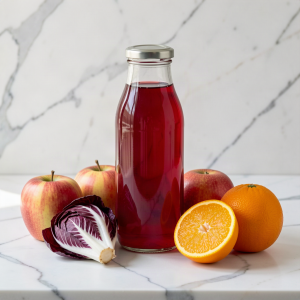
Radicchio, Apple and Orange Juice
Equipment
- 1 Juicer Any juicer works. A masticating or cold press juicer handles the soft radicchio leaves best; on a centrifugal machine feed them in behind the apple and orange so they do not wrap around the basket.
- 1 Budget cold press juicer The cheapest sensible way in if you are not sure how often you will juice.
- 1 High-speed blender For the blender method any decent blender will break this down in under a minute.
- 1 Nut milk bag Needed if you blend rather than juice, to squeeze the pulp out.
- 1 Airtight glass bottles It keeps for about a day in the fridge, though the bitterness softens, so it is best fresh.
Ingredients
- 1/2 small head radicchio about 120 g of Chioggia or Treviso radicchio, base trimmed and leaves separated
- 2 sweet apples crisp eating apples such as Gala or Pink Lady, about 300 g, cored and quartered but not peeled
- 1 orange a large one, about 180 g, peeled and pith removed
Instructions
Juicer method
- Trim the base off the radicchio and separate the leaves. About 120 g, half a small head, is the right amount for two glasses. A little goes a long way, and being brave with radicchio gives you a drink you have to force down.
- Quarter and core the apples but leave the skin on. The skin carries a lot of the flavour and the sweetness that balances the bitterness.
- Peel the orange and pull off as much of the white pith as you can. If you want the bitterness turned up rather than down, leave a thin strip of zest on one segment.
- Feed the apple and orange through the juicer first, then push the radicchio leaves through behind them. The firmer fruit gives the machine something to grip so the soft leaves come out as juice instead of clogging the basket.
- Stir, pour into a small glass and drink it ten to fifteen minutes before a meal. It keeps in a sealed bottle in the fridge for about a day.
Blender method
- Chop the radicchio, apples and peeled orange into pieces that fit your blender.
- Add 150 ml of cold water and blend on high for about 45 seconds until completely smooth.
- Pour the lot through a nut milk bag or a fine sieve and squeeze out as much liquid as you can. The pulp holds a surprising amount of juice.
- Serve the same way, in a small glass about ten minutes before you eat.