
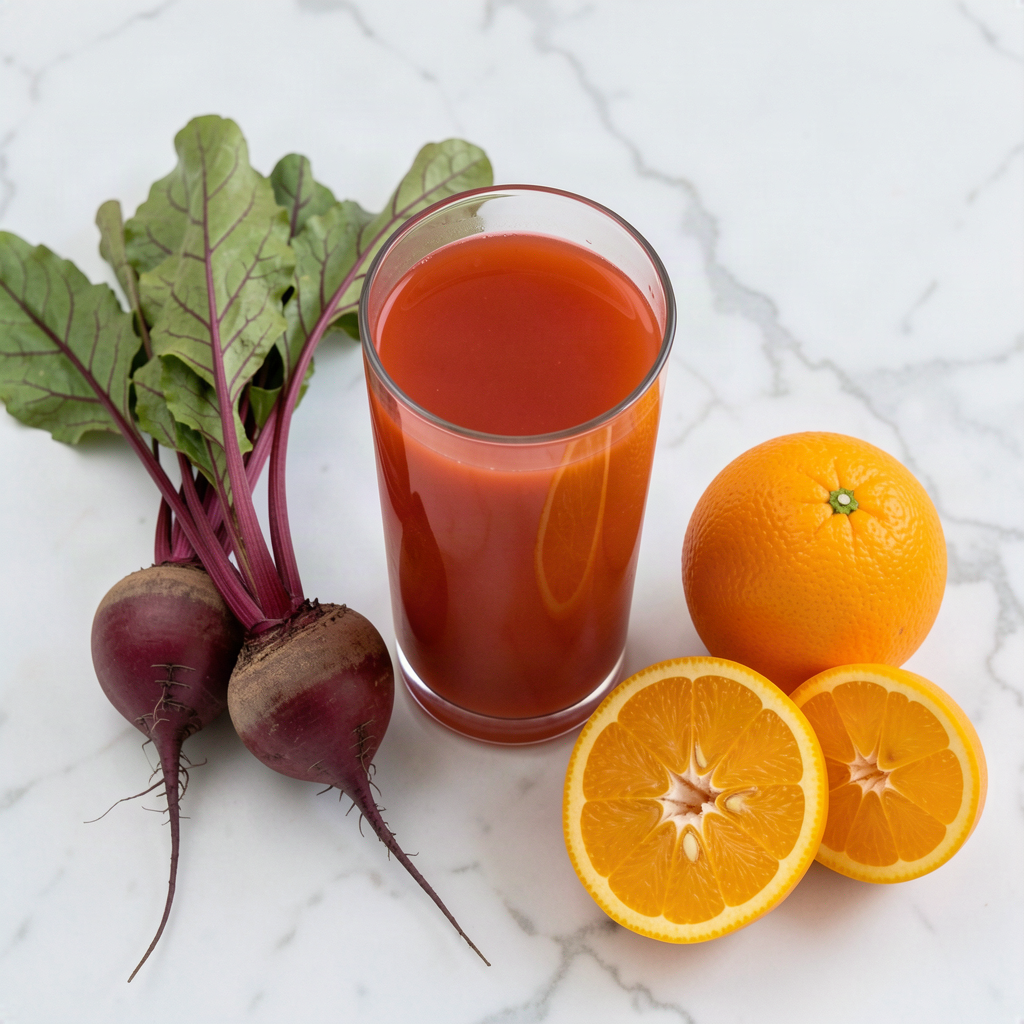
I started making this one on the days when the afternoon drags. Beetroot on its own is a bit much for me: too earthy, too sweet, and it can taste like the soil it came out of. A couple of oranges sorts that out. You still get the deep red colour and that earthy edge, but the orange keeps it bright enough that you want a second glass.
It is also the simplest way I know to get a decent dose of nitrate into an ordinary day. Two medium beetroot, two oranges, five minutes. A juicer is easier, but a blender and a nut milk bag does the same job, and both methods are on the card below.
Why these ingredients work
Beetroot is one of the few everyday vegetables with a proper amount of dietary nitrate. Your body converts that into nitric oxide, which relaxes and widens blood vessels, and that is where beetroot’s reputation with runners and cyclists comes from. The exercise studies mostly use a concentrated beetroot shot rather than a glass of juice, so treat this as a solid daily habit and not a performance product.
The oranges are not just there for the taste. Each glass gives you around 51mg of vitamin C, and vitamin C helps your body take up the plant iron in beetroot. Between them, one glass brings roughly 570mg of potassium, 165 micrograms of folate and 54mg of calcium. One honest caveat: beetroot is high in oxalates, so if you have had kidney stones, keep this as an occasional drink rather than something you have every morning.
FAQ
Can I make beetroot and orange juice in a blender?
Yes, and it is the version I make most often. Chop the scrubbed beetroot, peel and segment the oranges, add 100ml of cold water and blitz for 45 to 60 seconds until it is smooth. Strain it through a nut milk bag or a fine sieve, squeezing the pulp so you get all of the juice out. You end up with a slightly thicker drink and a bit more fibre than the juicer gives you.
Do I need to peel the beetroot?
No. Scrub it well under cold water, trim the leafy tops and the thin root tail, then leave the skin on. Most of the deep red pigment sits just under the skin, so peeling only costs you colour. If the beetroot is muddy, give it a longer scrub with a vegetable brush rather than reaching for the peeler.
When should I drink it?
I have mine in the morning, or about an hour before a long walk. Nitrate levels in the blood usually peak a couple of hours after you drink it, so there is no need to be precise about it. Beetroot juice separates as it sits, so give the glass a stir first, and finish anything you have bottled within 24 hours.
More energy recipes: see the full Energy collection.
Beetroot and Orange Juice
Equipment
- Nut milk bag
Ingredients
- 2 medium beetroot, scrubbed, tops trimmed (about 300g)
- 2 large oranges, peeled and segmented
Instructions
Juicer method
- Scrub the beetroot under cold water and cut off the leafy tops and the thin root tail. Leave the skin on, most of the colour sits just under it. Cut each one into quarters so it fits your feed chute.
- Peel the oranges and pull the segments apart, taking off the thick white pith but keeping as much flesh as you can. A bit of pith left on is not a problem.
- Feed the beetroot and orange through the juicer, alternating between the two. Beetroot on its own is dense and slow, and the orange going in alongside keeps everything moving.
- Give the juice a stir, then pour it into two glasses. Drink it straight away, or seal it in the fridge and finish it within 24 hours.
Blender method
- Chop the scrubbed beetroot into rough cubes and peel and segment the oranges.
- Put both in the blender with 100ml of cold water and blitz for 45 to 60 seconds until it is completely smooth.
- Pour it through a nut milk bag or a fine sieve set over a jug, squeezing the pulp so you get all of the juice out. Serve it cold.